

What is millwork in construction?
Millwork refers to custom-made wood or wood-based components used in building interiors, such as doors, cabinetry, mouldings, and trim. These are designed to meet specific architectural needs, blending function and style. Unlike structural elements like beams or flooring, millwork focuses on visible, finished details that enhance a space’s design.
Key points about millwork:
- Materials: Includes solid wood (like oak or maple), plywood, MDF, and laminates.
- Types: Architectural (decorative woodwork), custom (tailored pieces), commercial (business fixtures), and residential (home interiors).
- Cost: Typically 2–3× the price of raw materials; ranges from $500–$2,000+ per linear foot for custom projects.
- Production: Combines traditional craftsmanship with modern tools like CAD and CNC machines for precise results.
- Applications: Common in kitchen cabinets, doors, window frames, wall panels, and decorative trims.
Millwork is an investment in quality and design, lasting decades when crafted and installed properly.
Casework vs Millwork – What You Need to Know
sbb-itb-cb01839
What Is Millwork in Construction?
Millwork refers to custom-crafted building components made from wood or wood-based materials like plywood, MDF, or laminates. These include elements such as cabinetry, doors, window casings, baseboards, crown moulding, wainscoting, and mantels. These features are typically built into a structure’s design. On the other hand, if an item is free-standing, it’s generally classified as furniture instead.
Unlike structural components like studs, joists, or load-bearing beams – which are usually hidden behind drywall or flooring – millwork is part of the visible, finished interior. It serves as architectural woodwork that adds both style and functionality to a space.
Millwork plays a dual role: it’s decorative and practical. For example, cabinetry provides storage, doors define spaces and ensure privacy, and baseboards protect walls from everyday wear and tear. By using consistent finishes and detailing, millwork helps tie together a cohesive design across different areas of a building.
Because millwork requires skilled craftsmanship and precise execution, its cost is often two to three times higher than the price of the raw materials. While wood is the primary material, modern millwork can also incorporate glass, steel, aluminium, or plastic laminates to achieve specific design objectives. However, certain wood elements like flooring, ceilings, and siding typically fall outside the scope of millwork.
Next, let’s dive into the various types of millwork used in construction.
Types of Millwork in Construction
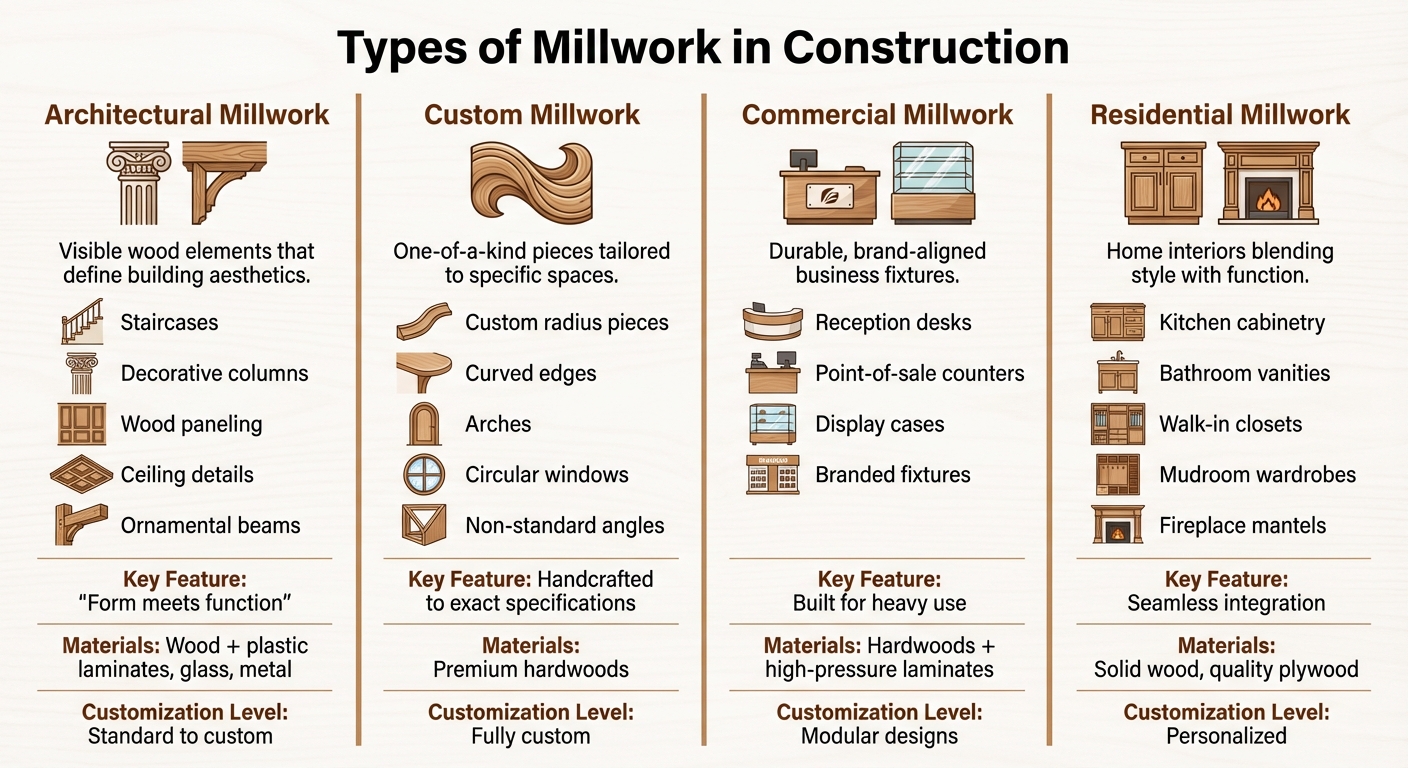
Types of Millwork in Construction: Comparison Guide
Millwork projects can be grouped into distinct categories based on their purpose and the level of customisation involved. Knowing these differences helps builders and homeowners make informed choices for their projects. Here’s a breakdown of the main types of millwork used in construction.
Architectural Millwork
Architectural millwork includes all the visible wood elements that become part of a building’s finish, such as staircases, decorative columns, wood panelling, ceiling details, and ornamental beams. These features often define a building’s overall aesthetic.
While wood is the primary material, modern architectural millwork often incorporates other materials like plastic laminates, glass, or metal to achieve specific design objectives. Depending on the project, this type of millwork can include both standard items and custom-crafted pieces. For projects requiring unique solutions, custom millwork is a step further.
Custom Millwork
Custom millwork is all about creating one-of-a-kind pieces tailored to fit specific spaces. It’s particularly useful for dealing with unusual design challenges, like non-standard angles or curved surfaces. This category includes specialised work, such as custom radius pieces for curved edges, arches, and circular windows – features that off-the-shelf products simply can’t provide. Each piece is handcrafted to exact specifications, offering unmatched design flexibility, though it often comes at a higher price.
Commercial Millwork
Commercial millwork plays a key role in shaping functional and visually appealing business spaces. It focuses on durability and brand alignment, with examples including reception desks, point-of-sale counters, display cases, and branded fixtures. These pieces are built to endure heavy use while maintaining their appearance. Modular designs are common, allowing businesses to adapt their spaces as needs change. Hardwoods and high-pressure laminates are frequently used to ensure the strength and longevity required in commercial settings.
Residential Millwork
Residential millwork focuses on enhancing home interiors, blending personal style with practical storage solutions. It includes items like custom kitchen cabinetry, bathroom vanities, walk-in closets, mudroom wardrobes, and fireplace mantels. The aim is to integrate these pieces seamlessly into the home’s architecture while maximising both organisation and aesthetic appeal. Residential millwork strikes a balance between beauty and everyday functionality, making it a cornerstone of home design.
Common Examples of Millwork in Buildings
Millwork plays a dual role in buildings, combining functionality with design to enhance both residential and commercial spaces. Here are some common examples that demonstrate its versatility.
Kitchen Cabinets and Built-In Storage
Custom kitchen cabinets are a classic example of millwork. Unlike mass-produced alternatives, these are crafted to fit the exact dimensions of your space. This precision ensures no awkward gaps and makes the most of every centimetre of storage.
Built-in storage isn’t limited to kitchens – it’s also a popular feature in bathrooms, closets, and other areas. These often include custom shelving and integrated lighting, tailored to specific needs. What sets them apart is their Engineered-To-Order (ETO) nature. Each piece is crafted in a mill based on detailed shop drawings rather than being pre-made and off-the-shelf.
The materials used in custom millwork cabinets also stand out. Solid wood or high-quality plywood is typically used, offering greater durability compared to the thinner engineered wood often found in factory-made casework. This makes investing in custom kitchen cabinets worth it as a long-term investment.
Doors, Window Frames, and Trim
Millwork extends to custom doors, window frames, and trim, designed to meet exact architectural specifications. Interior and exterior doors can be made as solid core for better soundproofing or hollow core for a more budget-friendly option. Custom doors can also reflect specific architectural styles, whether historical or modern.
Window frames, sills, and casings not only finish openings but also contribute to the overall aesthetic. Uniform profiles for features like baseboards and crown mouldings throughout a building create a sense of visual harmony.
Incorporating materials beyond wood – such as glass, steel, or aluminium – has become more common in modern millwork. These are especially popular in custom doors and windows where design and functionality intersect. This approach ensures these elements seamlessly align with the overall design of the space.
Wall Panels and Decorative Moldings
Wainscoting, wall panels, and decorative mouldings are millwork features that bring texture and depth to walls, tying a room’s design together. These elements can include everything from fireplace surrounds to decorative columns, faux ceiling beams, and corbels.
In homes, millwork often creates striking focal points. A floor-to-ceiling fireplace surround, for instance, can become the centrepiece of a living room. The type of wood selected also plays a key role: oak provides a bold grain and excellent durability, maple offers a smooth surface ideal for painting, and walnut delivers rich, dark tones suited for upscale designs
Materials Commonly Used in Millwork
The materials you pick for millwork play a big role in how durable, attractive, and cost-effective the finished product will be. These materials generally fall into two main categories: solid woods and engineered wood products. Each type has its own strengths, making it more suitable for specific uses. Let’s take a closer look at what each option offers.
Solid woods are further divided into hardwoods and softwoods. Hardwoods like Oak, Maple, and Walnut are favoured for furniture and cabinetry because of their strength and long-lasting nature. Softwoods, such as Pine, Cedar, and Fir, are often chosen for decorative elements or outdoor applications because they’re easier to work with and naturally resistant to decay. On the other hand, engineered wood products – like plywood, MDF, and veneer panels – are known for their stability and are often used as cost-effective alternatives to solid wood, especially for painted finishes or as a base for veneers.
“The choice of materials in millwork is a key factor in determining the durability, appearance, and overall quality of the finished product.” – David Spivac
Understanding these material options allows you to choose the best fit for your project, balancing looks, functionality, and budget.
Solid Wood
Solid wood is often the go-to choice for premium millwork projects. Hardwoods are especially valued for their strength and the natural beauty of their grain patterns, which add character to any design. For example, Oak is known for its prominent grain and resistance to moisture – White Oak, in particular, is a top pick for flooring, cabinetry, and stairs. Maple, with its light colour and even texture, is a versatile choice that works well with both paint and stain, making it a favourite for custom kitchen cabinets and countertops. Walnut stands out for its rich, dark tones and striking grain, making it ideal for high-end furniture and decorative wall panels.
Softwoods, on the other hand, are used in different ways. Cedar is a standout for exterior applications like siding and trim due to its natural resistance to rot and insects. Poplar, which has gained popularity over Pine for custom trim, offers a smoother surface for painting and is easier to work with. Mahogany, with its deep reddish-brown colour and excellent strength-to-weight ratio, is a premium choice for custom doors and luxury cabinetry.
Keep in mind that solid wood needs careful handling. Humidity control is essential during installation to avoid issues like warping or expansion, particularly with species like Maple and Oak.
Plywood and Engineered Wood
Plywood and other engineered wood products are known for their dimensional stability, which makes them less likely to warp or shrink compared to solid wood. Their cross-grain construction adds strength in all directions, making them a reliable choice for cabinet boxes, shelving, and structural bases. Plus, these materials come in large sheets, which helps reduce waste and speeds up production.
Plywood, for example, is a common choice for cabinet boxes even in high-end projects because it provides durability without the risk of warping seen in solid wood panels. Its strength-to-weight ratio makes it a practical option for applications where both sturdiness and weight matter.
Another advantage is cost. While solid hardwoods can be expensive, plywood and engineered wood products offer a more budget-friendly alternative without compromising on structural quality. These materials are often hidden behind veneers or finishes, allowing you to achieve the look you want while keeping costs manageable.
MDF and Veneer Panels
Medium Density Fiberboard (MDF) is a popular choice for painted millwork because of its smooth, consistent surface. Unlike solid wood, MDF has no visible grain, making it ideal for baseboards, crown moulding, and decorative panels. It takes paint exceptionally well and can be machined with precision, allowing for intricate designs using CNC equipment.
MDF is also a cost-effective option, especially for projects where painted finishes are specified. While solid wood is typically stained to highlight its natural beauty, MDF is almost always painted or covered with veneers or laminates. This makes it a practical choice for applications where the natural wood look isn’t a priority.
However, MDF does have its downsides. It can be damaged by moisture, particularly along cut edges if not properly sealed. It’s also heavier than both solid wood and plywood. Still, for projects requiring a smooth, flawless painted finish, MDF delivers great results at a lower cost than solid hardwoods.
The Millwork Manufacturing Process
Creating custom millwork involves several distinct phases, each requiring precision and teamwork. It all starts with detailed planning and culminates in the on-site installation. Understanding these steps sheds light on the craftsmanship behind each piece and ensures your project proceeds without a hitch.
Design and Shop Drawings
The journey begins with a collaborative effort between the client, designer, and millworker to define the architectural goals and functional needs. Every piece is custom-tailored to fit the specific dimensions of the building, ensuring a flawless outcome.
Using Computer-Aided Design (CAD) software, designers create precise digital models and detailed shop drawings. These drawings are more than just sketches – they include exact details about materials, finishes, joinery, and hardware. Clients review and approve these plans before production starts, helping to minimize unexpected changes down the road.
Modern tools like Virtual Reality (VR) and Augmented Reality (AR) give clients the ability to see how custom designs will look in their intended spaces, reducing mistakes in scale and placement. These digital designs integrate seamlessly with CNC machines, ensuring that the final product matches the approved model exactly. This digital blueprint sets the stage for the next phase: fabrication.
Fabrication and CNC Cutting
Fabrication happens in a controlled workshop environment – commonly referred to as a “mill” – where conditions allow for greater precision than on-site carpentry. Computer Numerical Control (CNC) machines handle intricate cuts and patterns that would be nearly impossible to achieve manually. In some high-end projects, 3D printing is also used to create prototypes or unique components.
“CNC technology has revolutionized millwork production, allowing for highly accurate cuts and intricate designs that would be challenging to achieve by hand.” – David Spivac
Once the pieces are cut and shaped, they move on to finishing. This stage involves applying paint, stain, or sealants, all chosen to suit the wood species and the desired aesthetic. Completing this step in a workshop ensures a consistent and polished result, something that’s harder to achieve on a busy construction site.
Installation on Site
After fabrication and finishing, the focus shifts to fitting the pieces into their final environment. This step requires skilled craftsmen to ensure that the millwork integrates seamlessly with the surrounding architecture. Coordination with other trades – such as glaziers for windows, countertop installers for cabinetry, or painters for final touches – is essential, particularly in complex projects where every element must align perfectly.
Before installation, it’s crucial to allow the wood to acclimate to the site conditions. This step helps prevent future issues like warping or movement. For species like Cedar, moisture metres are often used during installation to confirm the wood’s moisture content is just right. To keep everything on track, project management software is commonly employed to manage timelines, oversee design approvals, and coordinate installation teams, ensuring the project stays on schedule and within budget.
Benefits of Custom Millwork in Construction
Custom millwork enhances both the look and functionality of a space, offering long-lasting value that stands the test of time.
One of the key advantages is how tailored millwork fits perfectly into your space. Unlike mass-produced options, it eliminates gaps and integrates seamlessly with design elements like reception desks or point-of-sale counters, creating a polished and cohesive environment. This precision not only improves usability but also elevates the overall aesthetic.
Speaking of aesthetics, custom millwork plays a crucial role in establishing a consistent design theme throughout a building. Matching trims, baseboards, and crown mouldings contribute to a unified flow, while standout features like floor-to-ceiling fireplace surrounds or intricate mantels add dramatic focal points. The choice of wood species further personalizes the space – Mahogany, for instance, delivers a warm, dark red-brown elegance, while Walnut offers a rich, durable brown tone.
Durability is another standout feature. Custom millwork typically lasts 30 to 50 years, far outliving the 10 to 15 years expected from stock cabinetry. In kitchens, bespoke cabinetry is designed to match specific cooking routines and appliance needs, while custom closet systems maximize storage with adjustable shelving, built-in drawers, and dedicated spaces for all your belongings. Solid-core millwork doors provide excellent sound insulation, and custom-fitted windows and doors can improve energy efficiency, making them practical as well as beautiful. These qualities consistently set custom millwork apart from off-the-shelf alternatives.
Though custom millwork often requires a larger upfront investment, its long-term value makes it worth every penny. It significantly enhances resale appeal, especially in luxury markets where buyers value one-of-a-kind, high-quality finishes. Using solid hardwoods like oak, walnut, or maple ensures that these pieces can be refinished multiple times, avoiding the constant need for replacements. This “buy it once” approach not only saves money over time but also adds enduring economic benefits.
Cost Factors for Millwork in Construction Projects
When you’re planning a construction project – whether it’s a home renovation or a commercial build – understanding what drives millwork costs is key to managing your budget. The main factors to consider are materials, design, labour, and the scope of the project.
Material selection plays a huge role in determining costs. Choosing hardwoods like walnut, cherry, or oak can push material expenses up by 20–50% compared to more affordable options like softwoods or MDF. On average, the total cost of millwork is two to three times the cost of the raw materials. To keep costs in check, you might use premium hardwoods for high-visibility areas, such as a kitchen island or reception desk, while opting for budget-friendly materials like MDF or plywood for less prominent sections.
Design complexity is another major factor. Features such as integrated lighting, curved profiles, custom drawers, and high-end hardware not only increase fabrication time but also drive up costs. Professional shop drawings, which ensure precision, can add anywhere from $500 to over $2,500 to your budget. Custom millwork typically ranges from $500 to $2,000+ per linear foot, depending on the design and material quality. For example, a 20-foot custom kitchen cabinet setup might cost $10,000–$18,000 for budget options, $18,000–$30,000 for mid-range, and over $30,000 for premium finishes.
Labour and expertise are also significant contributors to overall costs. Skilled craftsmanship is essential for custom millwork, and labour rates tend to be higher in urban areas like Toronto due to increased overhead and demand for expertise. The entire process – from design to installation – generally takes 4 to 12 weeks, so starting your project at least three months in advance is crucial to avoid rush fees.
Lastly, the scope of the project can influence costs. Residential projects often focus on aesthetics and personalisation, such as luxury kitchens or custom closets, while commercial projects emphasize durability and brand representation for high-traffic spaces. When requesting quotes, confirm whether shop drawings and installation are included, as these can add significantly to your overall expenses.
How to Choose the Right Millwork Contractor
Selecting the right millwork contractor is crucial to ensuring your project meets the highest standards of design and craftsmanship. Start by assessing their workshop and equipment. A professional contractor should operate a dedicated facility where pieces are fabricated off-site in a controlled environment. This setup allows for unmatched precision, exact measurements, and polished finishes that are often superior to on-site carpentry. Don’t hesitate to ask for a tour of their workshop or inquire about their tools – modern contractors should utilize Computer-Aided Design (CAD) for precise modelling and Computer Numerical Control (CNC) machining for intricate and accurate cuts.
Next, review their portfolio to evaluate their expertise in custom and engineer-to-order (ETO) millwork projects. Focus on projects similar to yours – whether it’s a residential kitchen upgrade or a custom commercial reception area. Pay attention to the quality of finishes, attention to detail, and their ability to work with various materials. A skilled contractor should demonstrate proficiency with hardwoods like oak, maple, and walnut, prized for their durability, as well as softwoods like cedar and pine, often used for decorative accents. This step naturally leads into the consultation phase, where detailed shop drawings bring your vision to life.
Requesting shop drawings early in the process is a must. These drawings ensure your design preferences are incorporated and allow for precise measurements before production begins. Contractors who involve you during the design phase can better integrate custom elements into your building’s architecture, ensuring a seamless fit and aesthetic harmony.
Communication is another essential factor. A good contractor will take the time to understand your preferences for wood types, finishes – whether paint, stain, or sealant – hardware, and decorative details. Miscommunication or a poorly defined scope can lead to delays and unexpected expenses. To avoid this, ensure the contractor conducts a thorough site assessment to account for unique architectural features like curved walls, irregular angles, or other non-standard dimensions.
Finally, confirm their ability to collaborate effectively with other trades. Experienced millwork contractors work closely with glaziers, electricians, and countertop installers to ensure all components of your project are not only functional but also visually cohesive. This teamwork is key to achieving a flawless final result.
Conclusion
Millwork isn’t just about aesthetics – it plays a crucial role in defining both the functionality and overall style of a building. From custom cabinets to intricate crown mouldings, these wood elements combine practicality with a refined design. As David Spivac from hh2 puts it, “Millwork stands as a cornerstone in the construction industry, blending craftsmanship with functionality to create the detailed wood elements that define the character and design of buildings”.
While mass-produced options may be more affordable upfront, custom millwork offers unmatched precision, durability, and adaptability. Though it can cost two to three times more than the raw materials, its lifespan – ranging from 20 to 50 years – far surpasses the 10 to 15 years typical of factory-made cabinetry. This longevity, combined with the ability to fit curved walls, irregular angles, or unique architectural details, makes it the go-to choice for projects where quality and personalisation matter.
Modern millwork production blends traditional craftsmanship with cutting-edge CNC machining, enabling intricate designs with consistent precision. Material selection also plays a key role. Hardwoods like oak and maple are ideal for high-traffic spaces, while sustainable options with low-VOC finishes support environmentally conscious design. These choices not only enhance a building’s visual appeal but also ensure functional performance across diverse spaces, from residential kitchens to commercial reception areas.
To achieve seamless results, early planning and collaboration with design experts are essential. Working closely with specialists ensures that millwork integrates harmoniously into the architecture and aligns with the work of other trades. By prioritising quality materials, skilled craftsmanship, and precise installation, you can elevate ordinary spaces into ones that reflect lasting value and personal style.
FAQs
What does millwork include in construction?
Millwork in construction covers wood-based products crafted in a mill to improve both the look and utility of a building. This category includes items like doors, window casings, trim, moulding, cabinetry, wall panelling, and built-in shelving. Often tailored to specific needs, millwork is made from materials such as solid wood, plywood, MDF, or engineered wood. However, it doesn’t include structural components like flooring or siding unless they’re designed with a particular architectural intent.
What is the difference between millwork and casework?
The main distinction lies in how they’re made and their level of customisation. Millwork involves tailor-made wood products like doors, mouldings, and wall panelling, crafted to meet exact specifications. Casework, in contrast, consists of modular, factory-produced items such as cabinets and desks, usually made in standard dimensions. Millwork offers a more personalised and intricate approach, while casework is pre-assembled, cost-effective, and easier to install on-site.
Is cabinetry considered millwork?
Yes, cabinetry falls under the category of millwork because it is usually produced in a mill and customized to suit specific areas within a building. It often involves bespoke designs that improve both the practicality and visual appeal of residential or commercial interiors.
What materials are used in millwork?
Millwork commonly incorporates materials like solid wood, plywood, engineered wood, MDF, veneer panels, laminate, and composite materials. These options are popular due to their flexibility, strength, and adaptability to different construction and design requirements.
Why is custom millwork important in construction projects?
Custom millwork plays a key role in construction by offering made-to-measure solutions that boost both the look and practicality of a space. Whether it’s custom cabinetry, mouldings, or built-ins, this approach ensures every piece is crafted to fit specific dimensions and preferences. The result? A perfect fit, superior craftsmanship, and a personal touch that not only enhances the interior’s character but also adds lasting value to the property.