
How to Budget for Custom Kitchen Cabinets in 2026
Custom kitchen cabinets are a significant expense, often accounting for 30% to 40% of a kitchen renovation budget. In 2026, rising labour and material costs in Canada make planning even more important. Here’s what you need to know:
- Costs: Fully custom cabinets for a small kitchen (10×10 ft) start at $20,000 CAD and can exceed $50,000 CAD for larger spaces or luxury finishes. Semi-custom options range from $13,000 to $18,000 CAD.
- Materials: Plywood with veneer is durable and moisture-resistant, costing $250–$400 CAD per linear foot. Solid wood options like maple or cherry can reach $600 CAD or more per linear foot.
- Labour: Installation costs vary by region, typically adding $2,000–$6,000 CAD to your budget. Skilled labour accounts for 30%–50% of total renovation costs.
- ROI: Custom cabinets can recover 75%–80% of costs, with some projects reaching up to 113% in resale value.
To save, mix materials (e.g., plywood boxes with MDF doors), focus on high-use areas, and consider phasing your project. Always include a 10%–15% buffer for unexpected costs. Proper budgeting ensures a functional, long-lasting kitchen that adds value to your home.
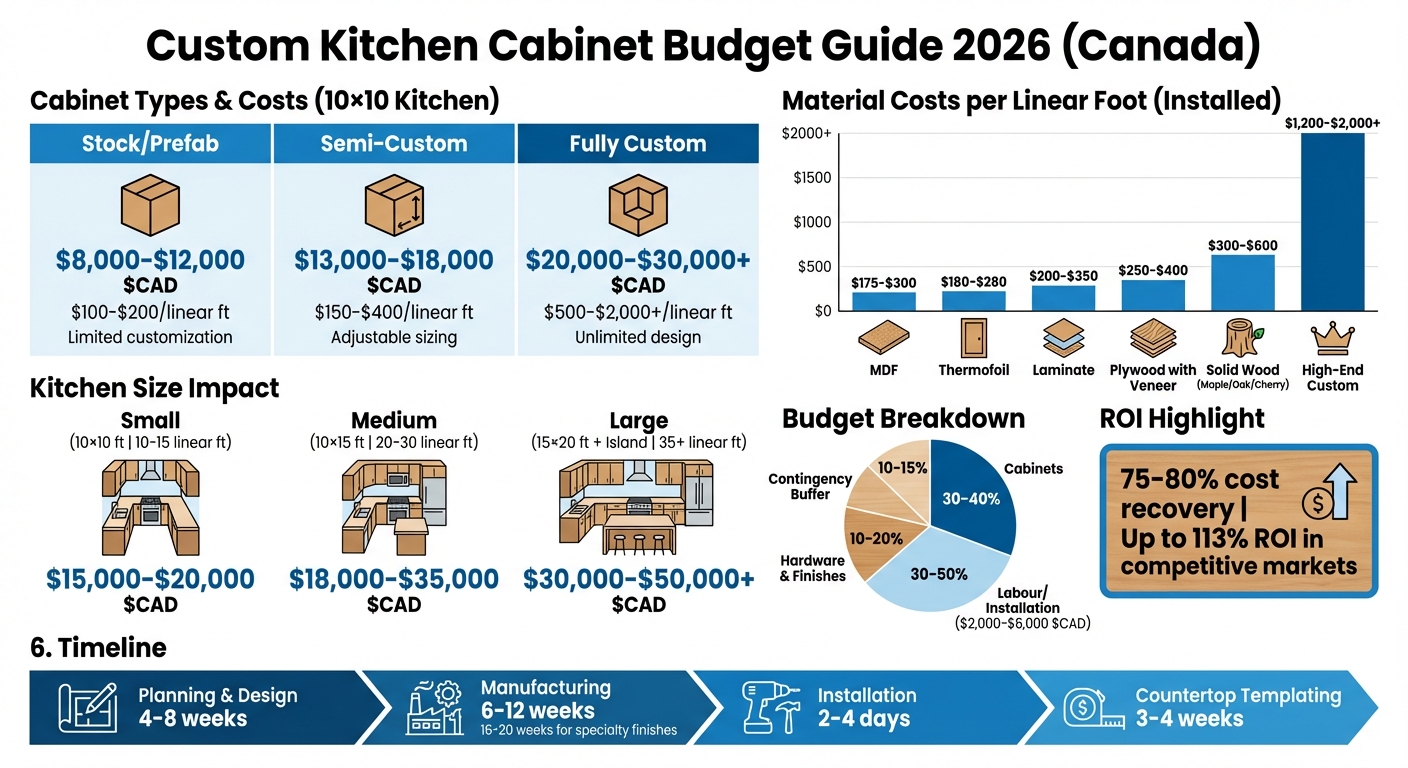
Custom Kitchen Cabinet Costs in Canada 2026: Complete Budget Breakdown by Type and Size
Why Custom Kitchen Cabinets Are a Smart Investment in 2026
Custom kitchen cabinets are built to last – often enduring 30 to 50 years – thanks to construction techniques like dovetail joints and solid wood drawer boxes. These durable features make custom cabinetry a wise financial choice in 2026.
Unlike mass-produced options, custom cabinets are typically made with high-quality plywood instead of cheaper particleboard. Plywood offers better screw retention, stronger structural support, and greater resistance to moisture – an important factor for Canada’s diverse climates. On top of that, hand-applied finishes on custom cabinets are far more resistant to chipping and wear compared to standard retail finishes.
Another advantage? Custom cabinets are designed to fit your kitchen perfectly. This eliminates the need for fillers and ensures every corner is utilized, which is especially useful in older Canadian homes with uneven walls or unusual angles. The result is a seamless, polished aesthetic that maximizes your space.
From a financial perspective, quality cabinetry in Canada often delivers a 75–80% return on investment, with some projects even reaching a 113% ROI. As real estate expert Larry Chun puts it:
If you have money to do new kitchen cabinets, it definitely boosts the value of the home because people spend a lot of time in the kitchen.
This means custom cabinets not only help recover costs but also enhance your home’s day-to-day functionality and appeal to future buyers.
Beyond their durability and financial benefits, custom cabinets are tailored to your specific needs. They can include features like pull-out towers for appliances, strategically placed charging drawers, or storage solutions designed around your cooking and entertaining habits. Unlike stock cabinets, which require you to adjust to their limitations, custom cabinets are designed to work for you – making them a practical and worthwhile investment for 2026.
sbb-itb-cb01839
Key Factors Influencing the Cost of Custom Kitchen Cabinets
Understanding what impacts the cost of custom cabinets is crucial for managing your kitchen renovation budget. Since cabinets typically make up 30% to 40% of the total renovation cost, knowing these factors helps you plan effectively.
Several key elements contribute to the cost: material selection, design complexity, hardware and finishes, kitchen size, and labour. Let’s break these down to help you fine-tune your budget.
Material Selection and Construction Quality
The material you choose significantly affects the price. Premium hardwoods like maple, oak, cherry, and walnut are among the priciest options, often raising material costs by 20% to 50% compared to alternatives.
Plywood with veneer finishes strikes a balance between durability and cost. It’s a popular choice for cabinet boxes due to its moisture resistance and structural strength – ideal for Canada’s varying climates. While plywood costs 20% to 30% more than particleboard, its durability helps avoid sagging and water damage over time.
For painted doors, MDF (Medium-Density Fiberboard) and HDF (High-Density Fiberboard) are common picks. These materials provide a smoother surface for lacquer finishes and are less prone to expansion or contraction due to temperature changes. HDF, in particular, performs well in Canada’s fluctuating weather, making it a great choice for painted shaker doors.
| Material Type (Installed) | Estimated Cost per Linear Foot (CAD) |
|---|---|
| MDF (Medium-Density Fiberboard) | $175 – $300 |
| Thermofoil | $180 – $280 |
| Laminate (Matte/Glossy) | $200 – $350 |
| Plywood with Veneer Finish | $250 – $400 |
| Solid Wood (Maple, Oak, Cherry) | $300 – $600 |
| High-End Custom (Exotic Woods/Finishes) | $1,200 – $2,000+ |
To manage costs, consider using premium hardwoods for high-visibility areas and more affordable materials for hidden interior sections.
Design Complexity and Custom Features
The complexity of your cabinet design can quickly drive up costs. Elaborate layouts with multiple corners, varying cabinet heights, or intricate moulding require more precision and labour, placing them in higher price brackets. Inset cabinetry, where doors sit flush with the frame, demands greater manufacturing skill and can cost up to 25% more than standard overlay styles.
Adding specialised storage features like pull-out towers, spice racks, or lazy Susans boosts functionality but also increases expenses. These internal systems can add anywhere from $100 to $500 per unit.
If your project requires professional shop drawings, expect to pay between $500 and $2,500+ before fabrication begins. Costs for custom millwork depend on the complexity of the design: basic styles range from $500 to $750 per linear foot, mid-range from $750 to $1,200, and intricate high-end designs from $1,200 to $2,000+ per linear foot.
Hardware, Finishes, and Accessories
High-end hardware and specialty finishes can add 10%–20% to your total cabinet costs. Soft-close hinges, full-extension drawer slides, and designer pulls from luxury brands are pricier than standard options. Basic hardware might add $50 to $300 to your budget, while premium selections push costs higher.
Specialty finishes like glazing, distressing, or high-gloss lacquers also increase expenses by 10%–20%. Matte and low-sheen finishes are gaining popularity in 2026 for their sleek look and fingerprint resistance. Custom paint colours or decorative elements like reeded door styles and integrated lighting further raise costs due to the additional labour involved.
To keep costs manageable, apply specialty finishes selectively, such as on a kitchen island or a feature wall.
Kitchen Size and Layout
The size and layout of your kitchen play a big role in determining costs. A smaller kitchen (around 10×10 ft or 10–15 linear feet) typically costs $15,000 to $20,000 for custom cabinets. Medium kitchens (10×15 ft or 20–30 linear feet) range from $18,000 to $35,000, while larger kitchens (15×20 ft with an island or 35+ linear feet) can cost $30,000 to $50,000 or more.
Unusual layouts, such as those with angled walls or multiple corners, require more customisation and fabrication, which increases costs. Designs for irregular spaces often move projects into higher pricing categories.
| Kitchen Size | Linear Feet | Estimated 2026 Custom Cost (CAD) |
|---|---|---|
| Small (10×10 ft) | 10–15 | $15,000 – $20,000 |
| Medium (10×15 ft) | 20–30 | $18,000 – $35,000 |
| Large (15×20 ft + Island) | 35+ | $30,000 – $50,000+ |
High-end features like floor-to-ceiling cabinetry, hidden fillers, and built-in appliance panels add a polished look but also increase material and labour requirements.
Labour and Installation Costs
Labour is a significant part of the total cost, often accounting for 30% to 50% of your kitchen renovation budget. In Ontario, professional installation costs range from $2,000 to $6,000, with skilled cabinet installers charging $50 to $200 per hour.
The complexity of installation depends on factors like the number of cabinets, design details, and whether structural changes are required. Electrical work for integrated lighting or plumbing adjustments for new sink placements will add to both time and labour costs.
Labour rates vary across Canada, with cities like Toronto, Vancouver, and Calgary typically charging more than smaller towns or rural areas. Production timelines for custom cabinets in 2026 range between 4 and 12 weeks, with installation taking an additional 1 to 2 weeks.
It’s wise to set aside 10%–20% of your budget as a contingency for unexpected challenges. Older homes, for example, may have uneven floors or walls that require additional work to address during installation.
Average Cost of Custom Kitchen Cabinets in 2026
As of 2026, the cost of custom kitchen cabinets in Canada can vary significantly based on the materials, design complexity, and level of customisation.
For a standard 10×10 kitchen, stock or prefab cabinets – which are mass-produced with limited options – cost between $8,000 and $12,000. Semi-custom cabinets, offering more adaptability in sizing and finishes, range from $13,000 to $18,000. If you’re looking for fully custom cabinetry, designed specifically for your space with endless design possibilities, prices typically start at $20,000 and can exceed $30,000. High-end luxury projects, featuring exotic materials and intricate details, can go beyond $45,000.
When considering custom millwork costs per linear foot, the pricing also varies:
- Basic custom millwork: $500 to $800 per linear foot
- Mid-range custom options: $750 to $1,200 per linear foot
- High-end intricate designs: $1,200 to $2,000+ per linear foot
In Toronto and the Greater Toronto Area (GTA), prices for materials like MDF custom cabinets average around $275 per linear foot installed, while solid wood custom cabinets cost approximately $450 per linear foot installed.
Installation costs are another important factor. In Toronto, the average cost for kitchen cabinet installation is $5,823, though most homeowners spend between $1,900 and $9,741, depending on the project’s size and complexity. Professional installation typically adds $2,000 to $6,000 to the overall budget.
Here’s a quick breakdown for reference:
| Cabinet Type | Customisation Level | Estimated Cost (10×10 Kitchen) | Price per Linear Foot |
|---|---|---|---|
| Stock / Prefab | Limited sizes and finishes; mass-produced | $8,000 – $12,000 | $100 – $200 |
| Semi-Custom | Adjustable sizing; more finish options | $13,000 – $18,000 | $150 – $400 |
| Fully Custom | Tailored to exact layout; unlimited design | $20,000 – $30,000+ | $500 – $2,000+ |
How to Create a Realistic Cabinet Budget
When planning a kitchen renovation, cabinets often account for a significant portion of the expenses. Taking the time to estimate costs accurately can help you avoid unexpected financial surprises down the road.
Measuring Your Kitchen and Determining Cabinet Needs
Start by sketching your kitchen layout, noting walls, obstacles, and any protrusions. Measure the ceiling height and wall widths, and use the 3-4-5 rule to confirm square corners. Be meticulous – mark the locations of plumbing, electrical outlets, light switches, and vents, noting precise measurements. For windows, measure from the outer edges of the trim, and don’t forget to include freestanding appliances like your stove, refrigerator, and dishwasher in your plan.
To calculate the linear footage needed for cabinets, measure the total length of walls where cabinets will be installed. Subtract the width of any windows, doors, appliances, or walkways. On average, a typical kitchen requires about 30 cabinet boxes, with custom cabinets costing between $500 and $1,500 per box.
Once you’ve completed your measurements, align them with your design and material choices to refine your budget.
Factoring in Customisation Levels and Material Choices
With your linear footage in hand, decide on the level of customisation that suits your budget. Here’s a quick breakdown of costs:
- Stock cabinets: $230–$290 per linear foot
- Semi-custom cabinets: $320–$400 per linear foot
- Fully custom cabinets: $450 to over $2,000 per linear foot
The materials you select also play a major role in shaping costs. For instance:
- MDF: $175–$300 per linear foot
- Plywood with veneer: $250–$400 per linear foot
- Solid wood (e.g., maple or oak): $300–$600 per linear foot
"Custom cabinetry typically represents 35-40% of your total kitchen renovation budget."
To get the most for your money, focus on high-quality finishes for visible areas like doors and drawer fronts, which endure the most wear and tear. For interiors, consider more economical materials. Keep standard dimensions in mind – base cabinets are usually 24 inches deep, while upper cabinets are 12 to 13 inches deep.
After finalising your materials and design, don’t forget to account for installation and related services.
Accounting for Additional Costs and Contingency
Cabinet costs go beyond just the boxes. Here are some additional expenses to consider:
- Professional installation: $2,000–$6,000
- Shop drawings (if needed): $500–$2,500
- Cabinet removal and disposal: $300–$500
For added details like crown moulding, light valances, or custom inserts, expect to pay around $10 per linear foot.
It’s also wise to include a 10–15% contingency buffer for unexpected issues. This could cover structural repairs, electrical adjustments, or material changes. In older Ontario homes, for example, uneven plaster walls often require custom scribing to ensure cabinets fit perfectly, which can increase labour costs.
If your renovation involves moving plumbing or electrical lines, plan for 1–4 weeks to secure municipal permits. You should also allocate 2–5% of your budget for permits, inspections, and disposal fees.
Strategies to Reduce Costs Without Sacrificing Quality
Custom cabinets don’t have to break the bank. With thoughtful planning, you can achieve a polished, high-end look while keeping costs under control. These tips build on the cost factors and budgeting methods discussed earlier.
Choosing Cost-Effective Material Combinations
Mixing materials is a smart way to balance quality and cost. For example, use plywood for cabinet boxes and pair it with MDF or HDF for door fronts. This combo ensures durability where it matters and provides a smooth, paintable surface for visible areas.
"Using MDF or plywood boxes with wood veneer fronts is a cost-effective alternative without sacrificing appearance or durability."
If you prefer a natural wood look, consider plywood with a veneer finish. It replicates the appearance of solid hardwood but can cut costs by up to 50% compared to using solid wood.
Focusing on Key Features and Skipping Extras
Spend your budget on high-use areas like doors, drawer fronts, and hardware, while using more affordable materials, such as melamine, for cabinet interiors. Opt for simple door styles like Shaker or flat-panel designs, which are less expensive to produce and offer a timeless aesthetic.
To save even more, limit the number of drawers in your design. Base cabinets with drawers often require costly soft-close mechanisms and specialised hardware. Standard door cabinets can provide ample storage at a lower price. Additionally, avoid relocating plumbing or electrical fixtures, as these changes can significantly increase labour costs.
Skipping decorative elements, such as crown moulding, light valances, or custom range hoods, can also reduce expenses. Depending on their complexity, these extras can add anywhere from $500 to $10,000 to your budget.
If you’re looking to save further, consider spreading out your project over time.
Phasing Projects to Manage Costs
Breaking your renovation into phases can help you stay within budget while still achieving a functional and attractive kitchen. Start with essential elements, like high-quality cabinet boxes, and add premium features later. A hybrid approach works well: use semi-custom cabinets for standard areas and save fully custom options for standout pieces, such as a kitchen island or pantry. This method can reduce overall costs by 20% to 40%.
"Consider phased renovation approaches for tight budgets. Complete cabinet installation first, then upgrade countertops and appliances in subsequent phases. This strategy spreads costs over time while providing immediate kitchen improvements."
When adopting a phased approach, it’s important to finalise all material and finish choices upfront. This avoids problems with mismatched colours or discontinued styles. You can also start small by adding floating shelves or accent built-ins, which typically cost between $3,000 and $10,000, as an initial phase before committing to a full installation. Make sure your initial design accommodates future upgrades so that additional features integrate seamlessly when you’re ready.
Timeline and Payment Planning for Custom Cabinets
Getting a handle on the timeline and payment structure for custom cabinets is key to managing your budget and keeping your renovation on schedule. Production only begins after finalizing the design and preparing your kitchen.
Production and Installation Timelines in 2026
From the moment your design is approved, a custom cabinet project typically takes 6 to 12 weeks to move from production to installation. Before that, the planning phase – where you choose materials, door styles, and hardware – can take 4 to 8 weeks. Once the design is locked in, manufacturing generally spans 6 to 12 weeks, though specialty finishes can extend this to 16–20 weeks.
"Cabinet production lead times are influenced just as much by decisions made during planning and preparation as they are by factory timelines."
Before your cabinets arrive, ensure framing, drywall, and flooring are complete. Installation itself usually takes 2 to 4 days, but additional finishes might add up to 2 weeks. After installation, countertops need to be templated, which adds another 3 to 4 weeks to the overall schedule.
Keep in mind, you’ll need 2 to 4 weeks for municipal permits and should order panel-ready appliances 8 to 12 weeks ahead of time. Proper planning not only keeps your project moving but also helps you stay within budget by avoiding unexpected delays and costs.
Deposit and Milestone Payment Structures
Once your timeline is set, a structured payment plan ensures a smooth process. Most professional cabinet makers use milestone-based payment schedules that protect both the client and the contractor. These typically include an initial deposit to secure your production slot, a progress payment when manufacturing begins or materials are sourced, and a final payment upon installation completion.
"Quality cabinet makers provide detailed contracts specifying materials, timelines, and payment schedules. Avoid contractors demanding large upfront payments."
Before paying a deposit, confirm the cabinet maker’s insurance and check their references. Your contract should clearly outline what each payment covers and when it’s due. Be aware that shop drawings may carry separate fees.
Return on Investment: Do Custom Cabinets Increase Home Value?
Custom kitchen cabinets can significantly boost a home’s resale value in Canada, often allowing homeowners to recover 75%–80% of their investment. In competitive markets like Toronto, Oakville, and Vaughan, this return can even climb to as high as 113%. These figures highlight the financial advantages of incorporating high-quality, custom cabinetry into a kitchen renovation. It also emphasizes the importance of careful budgeting and selecting durable materials, as discussed earlier.
But it’s not just about the numbers – custom cabinets also convey a sense of quality that appeals to potential buyers. Features like dovetail joinery and soft-close hinges showcase craftsmanship that stock cabinets simply can’t replicate. Homes with modern, upgraded kitchens tend to sell faster and closer to their asking price, adding another layer of value to custom cabinetry.
"Buyers often make decisions based on the kitchen alone. Custom cabinetry creates that ‘wow’ factor that gives sellers a competitive edge."
- Eugene Bershadsky, Senior Designer and Sales Manager, Impressions Kitchens
Functionality plays a big role too. Custom layouts are especially valuable in irregular or older homes, where stock cabinets might leave awkward gaps filled with unattractive panels. With custom designs, every inch of space is optimized, which not only improves usability but also appeals to buyers looking for a well-thought-out kitchen.
To get the most out of your investment, focus on visible quality details like premium doors, drawer fronts, and hardware. Opt for durable materials – such as HDF for painted finishes or plywood for cabinet boxes – to ensure your kitchen maintains its pristine condition over time. While stock cabinets often last 10–15 years, custom models can endure for over 25 years. Pairing these with professional lighting, high-quality countertops, and a cohesive backsplash can further elevate the space and its perceived value. These insights can help guide your budgeting decisions when planning for custom kitchen cabinets in 2026.
Final Budgeting Checklist for Custom Kitchen Cabinets in 2026
Here’s a quick checklist to ensure you’ve covered all the key costs for your custom kitchen cabinets:
- Core fabrication costs: Account for quality materials like wood species, MDF, or plywood, along with skilled labour to ensure precision manufacturing.
- Professional installation: Set aside 25% to 40% of your total cabinetry budget for this, translating to about $200 to $300 per linear foot.
- Shop drawings and renderings: Check if fees ranging from $500 to $2,500 are included in your quotes.
- Site preparation: Don’t overlook costs like cabinet removal and disposal ($350–$800) or necessary plumbing and electrical changes ($1,000–$3,000).
- Finishing touches and hardware: Budget for details like crown moulding ($4–$23/ft), knobs and pulls ($2–$50 each), soft-close upgrades ($20–$50 per unit), pull-out shelves ($150–$400 each), and under-cabinet lighting ($85–$300 per fixture).
- Contingency fund: Reserve an extra 10% to 15% of your total budget to cover unexpected costs, especially in older homes.
Make sure your quotes include shop drawings, delivery, and installation, as these items are often charged separately. It’s also a good idea to gather at least three detailed quotes to confirm accurate pricing for 2026.
This checklist ensures every expense aligns with your renovation plan, giving you a clear and organized approach to budgeting for your dream kitchen.
FAQs
How many linear feet of cabinets do I need?
The amount of linear feet of cabinets you’ll need hinges on the size and layout of your kitchen. Start by measuring the total length of the walls where cabinets will be installed, making sure to account for appliances and any custom features. As a guideline, a standard 10×10 kitchen usually requires around 12 to 15 linear feet of both base and upper cabinets. This calculation provides a solid starting point for estimating the cabinet space you’ll need.
What’s the best cabinet material for Canadian humidity?
Solid wood is the top choice for cabinets in Canada’s humid conditions. When sealed and cared for correctly, it provides strong durability and handles moisture well, making it a reliable option for areas with varying humidity.
How can I cut cabinet costs without looking cheap?
To keep cabinet costs manageable without giving up on style, consider using cost-effective materials like laminate or MDF instead of pricier hardwood. Stick to simpler designs by skipping elaborate details, and select finishes and hardware that look great but don’t break the bank. You can also cut expenses by tackling smaller tasks yourself – like painting or attaching hardware – helping you achieve a polished, stylish result without overspending.