
How Long Do Custom Cabinets Last Compared to Prefab?
Custom cabinets generally last 20–30 years, while prefab cabinets often need replacing after 5–10 years. The difference comes down to materials, craftsmanship, and construction methods. Custom cabinets use durable materials like solid wood or high-grade plywood, while prefab options rely on lower-quality materials like particle board or MDF, which are prone to moisture damage and wear.
Here’s a quick breakdown:
- Custom Cabinets: Last 20–30+ years, cost $500–$1,200 per linear foot, made from solid wood or plywood, and can be refinished.
- Prefab Cabinets: Last 5–10 years, cost $75–$400 per linear foot, made from particle board or MDF, and often require full replacement.
While prefab cabinets are cheaper upfront, their shorter lifespan means replacing them multiple times over 20–30 years can cost more than investing in custom cabinets. Custom options also add long-term value to your home and are tailored to fit your space perfectly. Prefab cabinets are better suited for short-term needs or budget-conscious projects like rental properties or secondary spaces.
Quick Comparison:
| Factor | Custom Cabinets | Prefab Cabinets |
|---|---|---|
| Lifespan | 20–30+ years | 5–10 years |
| Materials | Solid wood, plywood | Particle board, MDF |
| Cost (CAD) | $500–$1,200/linear ft | $75–$400/linear ft |
| Durability | Refinishable, sturdy | Prone to damage, warping |
| Installation | Professional required | DIY or professional |
Custom cabinets are ideal for long-term durability and resale value, while prefab cabinets are a short-term, cost-effective solution.
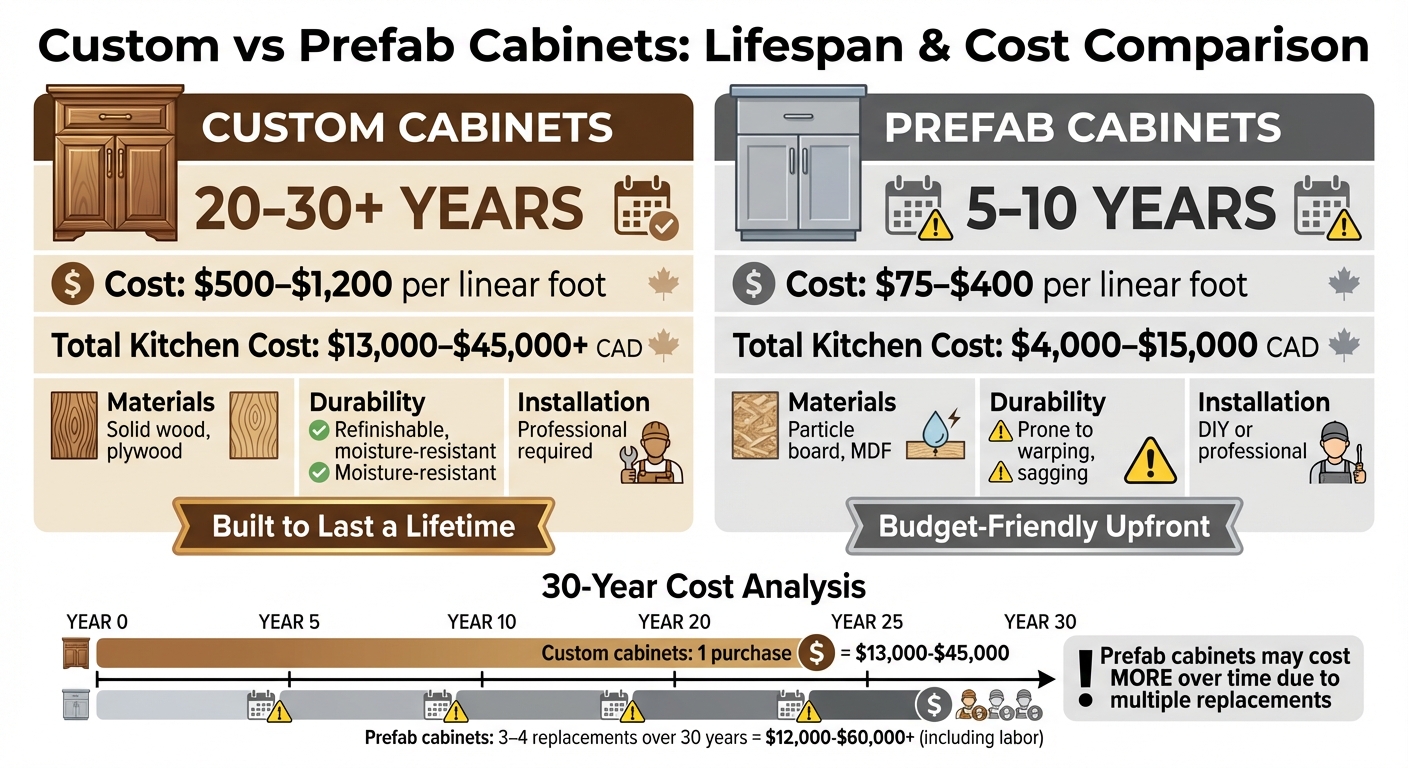
Custom vs Prefab Cabinets Lifespan and Cost Comparison
Kitchen Cabinets: Stock vs Semi-Custom vs Custom (full breakdown)
sbb-itb-cb01839
What Determines the Lifespan of Kitchen Cabinets?
The longevity of your kitchen cabinets depends on several key factors. Knowing what influences their durability can help you make an informed decision when choosing the right cabinets for your home.
Material Quality
The materials used in cabinet construction play a huge role in how long they last. Custom cabinets often use solid wood or high-grade plywood, which stand up better to moisture and wear compared to cheaper alternatives. As Erin Maleska, Designer at Bound Collaborative, points out:
"The least expensive prefab cabinets are commonly made of MDF which is not recommended."
Kitchens are exposed to humidity, steam, and temperature changes, which can cause low-quality materials to swell or warp. Solid wood and plywood handle these challenges much better and can even be refinished or painted to extend their life.
The way these materials are put together also matters.
Construction Methods and Joinery
The construction and joinery techniques used in cabinets directly impact their durability. Custom cabinets are built with reinforced corners, thick side panels, and full back panels, ensuring they can handle heavy use over time. High-quality joinery prevents problems like joint separation or sagging. On the other hand, mass-produced cabinets often rely on staples or glue, which are less reliable under stress.
RTI Cabinets highlights the importance of precision:
"One of the clearest signs of cabinet quality is alignment. High-quality cabinets maintain even door spacing, smooth drawer operation, and secure mounting."
This attention to detail ensures that custom cabinets maintain their structure and functionality for years, while poorly constructed options can suffer from misaligned doors and shifting components.
Hardware and Hinges Durability
Cabinet doors and drawers are used daily, so the durability of their hardware is crucial. Features like soft-close hinges and full-extension drawer slides not only improve usability but also reduce wear and tear on the cabinet structure. Cheaper hardware tends to wear out faster, leading to misaligned doors or the need for early replacements.
Installation Quality
Even the best materials and construction won’t matter if the cabinets aren’t installed correctly. Professional installation ensures cabinets are securely mounted and aligned, which is especially important in areas with seasonal temperature and humidity changes. Custom cabinets typically benefit from expert installers who tailor the setup to each piece. On the flip side, ready-to-assemble (RTA) cabinets can suffer from alignment issues if not installed with care. Proper installation ties together the materials, construction, and hardware, ensuring the cabinets last as long as possible.
Daily Usage and Maintenance Habits
How you use and care for your cabinets also plays a role in their lifespan. Regular cleaning helps maintain the finish, but it’s important to avoid letting moisture collect at the joints, as this can lead to swelling or separation. In Canada, where seasonal temperature changes and humidity fluctuations are common, keeping indoor conditions stable is especially important. Simple maintenance tasks, like tightening loose hinges or fixing sagging shelves, can prevent small problems from becoming big ones.
As RTI Cabinets notes:
"Durable kitchen cabinets use stable materials and proper sealing to resist moisture-related expansion and contraction."
How Long Do Custom Cabinets Last?
Average Lifespan of High-Quality Custom Cabinets
Custom cabinets built with care and precision can last 20–30 years. That’s a significant upgrade compared to prefab cabinets, which often need replacing within 5–10 years. The reason? Premium materials, expert craftsmanship, and solid construction methods create cabinets designed to withstand decades of use.
Some manufacturers even go further. According to Lifetime Kitchens:
"Our custom cabinets are BUILD TO LAST A LIFETIME!"
Why Custom Cabinets Typically Last Longer
The longevity of custom cabinets comes down to the materials and construction techniques used. Instead of particle board, these cabinets are often made from solid wood or furniture-grade plywood, such as maple or birch. These materials are far better at handling humidity and temperature changes without warping or degrading.
Construction quality is another key factor. Custom cabinets are built with reinforced boxes, thicker side panels, and solid back panels, giving them a sturdy structure that can last for decades. Precision joinery ensures everything fits securely, while premium hardware – like BLUM soft-close hinges and full-extension drawer slides – ensures smooth operation for thousands of uses. Many of these hardware components even come with lifetime warranties.
As RTI Cabinets puts it:
"True durability shows up years after installation, not just on day one".
These qualities make custom cabinets a long-term investment that stands the test of time.
Real-Life Examples of Long-Lasting Cabinetry
Lifetime Kitchens, based in North York, Toronto, has been crafting custom cabinets for homeowners in the Greater Toronto Area since 1999. Their cabinets are 100% Canadian-made, combining high-quality plywood with top-grade hardware. Over their 25+ years in business, they’ve built a reputation for delivering cabinets that truly last.
Thanks to their focus on durable materials and expert craftsmanship, Lifetime Kitchens confidently markets their products as built to last a lifetime. With proper care, these cabinets avoid the common issues seen in lower-quality options, such as sagging shelves, warped panels, or failing hardware. This durability not only saves homeowners from frequent replacements but also proves why custom cabinetry is a smart, long-term choice for Canadian homes.
How Long Do Prefab Cabinets Last?
Average Lifespan of Stock and RTA Cabinets
Prefab cabinets typically last 5–10 years before showing signs of wear or needing replacement. This is a noticeable difference compared to the 20–30 years you can expect from custom cabinets. The main reason for this shorter lifespan lies in the materials – particle board is commonly used in prefab cabinets, making them less resistant to moisture and everyday stress. While the quality of materials does play a role in durability, the lower-grade components often used in prefab options limit how long they last.
Stock and ready-to-assemble (RTA) cabinets are produced in standard sizes, offering limited options for customisation in terms of dimensions, finishes, or depths. This mass-production approach helps keep costs affordable, with prices ranging between $3,000 and $12,000 for a full kitchen. However, these cost savings often come at the expense of durability and design flexibility.
Common Issues That Reduce Durability
Prefab cabinets are more vulnerable to certain problems that custom cabinets are better equipped to handle. For instance, exposure to moisture can lead to warping or swelling, especially in base cabinets near sinks or dishwashers where water can seep into the particle board.
Hardware quality is another concern. Hinges and slides often wear out faster, causing doors to sag and drawers to stick or fail to close properly over time. Changes in temperature and humidity can also cause the wood to expand or contract, leading to misaligned doors, gaps between panels, and drawers that no longer operate smoothly. Additionally, everyday kitchen conditions – like grease, smoke, and dust – can cause discolouration and degrade the cabinet’s finish.
When Prefab Cabinets Make Sense
Prefab cabinets are a practical choice in situations where budget and ease of replacement are key priorities. They’re especially useful for rental properties, where landlords need affordable, functional solutions that can be replaced without much hassle. They also work well for quick renovations or temporary updates when a long-term investment isn’t the goal.
For DIY enthusiasts, prefab cabinets are appealing because they’re easy to install and can be finished on-site, eliminating the need for professional help. They’re also a smart option for secondary spaces like laundry rooms, garages, or workshops, where aesthetics take a back seat to functionality. If you enjoy updating your kitchen’s look every few years or plan to renovate in stages, the lower upfront cost of prefab cabinets makes them a more manageable option for periodic replacements. Knowing these trade-offs can help you weigh your options more effectively.
Custom vs Prefab Cabinets: Side-by-Side Comparison
When it comes to cabinet longevity, cost, and materials, the differences between custom and prefab cabinets are clear-cut. Here’s a breakdown to help you understand what sets them apart.
Custom cabinets, crafted from high-quality materials like solid wood and plywood, typically last between 20 and 30 years. In contrast, prefab cabinets, often made from particle board or MDF, usually need replacing after just 5 to 10 years.
The cost difference is just as striking. Outfitting a full kitchen with custom cabinets can cost anywhere from $13,000 to $45,000+ CAD, while prefab options are more budget-friendly, ranging from $4,000 to $15,000 CAD. Installation costs also vary significantly: custom cabinets can run $500 to $1,200 per linear foot, while prefab options are more affordable at $100 to $500 per linear foot. Another advantage of custom cabinets is that they can be refinished over time, whereas prefab cabinets are often replaced entirely when they show wear.
Comparison Table
| Factor | Custom Cabinets | Prefab Cabinets |
|---|---|---|
| Lifespan | 20–30+ years | 5–10 years |
| Materials | Solid wood, plywood | Particle board, MDF |
| Costs (CAD) | $13,000–$45,000+ | $4,000–$15,000 |
| Durability | Refinishable, moisture-resistant | Prone to sagging, warping |
| Installation | $500–$1,200 per linear foot | $100–$500 per linear foot |
| Customisation | Unlimited sizing and finishes | Limited to standard dimensions |
Custom cabinets stand out for their moisture resistance and durable construction, making them a reliable choice for daily use. Plus, they can add resale value to your home, an advantage that prefab cabinets often can’t match.
Signs Your Cabinets Need Replacement or Upgrade
Replacing cabinets at the right time can save you from costly water damage and a lot of frustration. One of the most obvious red flags is moisture damage, especially in prefab cabinets made from particle board. If you notice swelling or warping at the base of your cabinets, it’s a clear sign that moisture has started to seep in, compromising their structure.
Another warning sign is when your cabinets start to lose their functionality. Sagging doors or poor alignment often point to deeper structural problems. If your cabinet doors no longer close properly or drawers constantly stick, this could indicate that the materials have weakened – something that’s pretty common after 5–10 years of use in prefab units. These alignment issues can also put extra stress on the cabinet components, leading to more frequent problems.
Loose hinges and stripped screws are another concern. If screws are loosening or hinges are coming undone, it’s often because the particle board is crumbling and can no longer hold the hardware securely. On the other hand, custom cabinets made with plywood or solid wood cores tend to last much longer, keeping hinges and screws firmly in place for decades.
Surface damage is another clue that it might be time for a replacement. A peeling or delaminating finish is a visual sign that moisture has damaged the protective coating. While factory finishes on prefab cabinets may look great initially, they typically have lower resistance to moisture and wear out faster in busy kitchens. If you find yourself constantly touching up chips and peels, it might make more sense to invest in new cabinets rather than continuing with repairs.
Lastly, think about whether your cabinets meet your current storage needs. Do they include modern conveniences like soft-close drawers, spice racks, or integrated waste systems? If not, upgrading to custom cabinets could provide these features along with better durability, making replacement a smarter long-term investment.
How to Extend the Life of Any Cabinets
Taking care of your cabinets goes a long way in protecting your investment. While quality materials and craftsmanship lay the foundation, proper maintenance ensures they stay in great shape for years.
One of the most important steps is guarding your cabinets against moisture and heat. Kitchens naturally face challenges like steam, humidity, and cooking heat. To combat this, make it a habit to use your range hood when boiling water or running the dishwasher. This helps reduce moisture buildup, which can damage materials like particle board over time.
Another critical aspect is keeping an eye on hardware. Cabinet doors and drawers go through heavy use – thousands of openings and closings each year. Tightening hinges and realigning doors regularly prevents sagging and unnecessary strain. If you notice uneven doors or drawers that stick, addressing these issues early can save you from costly repairs down the line. Upgrading to soft-close hinges and full-extension drawer slides is also a smart move to minimize wear.
Maintaining humidity levels in your kitchen between 40–60% is equally important. This prevents the expansion and contraction that can cause warping or joint separation. Since Canadian homes often experience significant seasonal temperature swings, even the sturdiest cabinets benefit from a stable environment. Paying attention to these factors can help you catch small issues before they turn into major repairs.
Finally, learn to differentiate between normal wear and more serious problems. Light surface dulling is expected over time, but signs like sagging shelves, sticking drawers, or separating joints indicate deeper structural issues. Tackling these promptly can prevent further damage and save you money in the long run.
Are Custom Cabinets Worth the Investment?
The cost of custom cabinets typically ranges from $10,000 to $35,000+, while prefab cabinets fall between $3,000 and $12,000. At first glance, prefab options seem more budget-friendly, but when you factor in lifespan and replacement frequency, the story changes. Prefab cabinets often need replacing multiple times over a 30-year span, potentially three to four times. Even at the lower end of the price range ($3,000), the combined cost of materials and labour for these replacements can easily match or exceed a one-time investment in custom cabinetry. Custom cabinets, built to last, avoid these recurring expenses and provide a durable solution for decades.
Beyond the financial aspect, custom cabinetry adds real value to your home. High-quality materials not only last longer but also enhance your home’s appeal. This means fewer repairs, sturdier hardware, and a kitchen that looks great for years. For homeowners planning to stay put, custom cabinets eliminate the awkward gaps and fillers often required with stock options, especially in kitchens with unusual layouts. This makes them an excellent choice for both personal residences and income properties.
That said, prefab cabinets might be the better option for short-term situations, like renovating a rental property or a starter home you plan to leave within a few years. But if you’re thinking long-term – especially for kitchens with tricky layouts – custom cabinets offer better durability, efficient use of space, and increased resale value. Over time, this investment pays off through fewer repairs, optimized functionality, and a timeless design that holds its appeal.
Another advantage? Custom cabinetry is considered a structural component of the home, which allows for tax depreciation over 27.5 years for residential rental properties. In contrast, removable prefab cabinets depreciate over just 7 years. This tax benefit further underscores the long-term value of choosing custom cabinets.
Which Option Lasts Longer and Why
When it comes to durability, custom cabinetry takes the lead, lasting 20–30 years compared to the 5–10-year lifespan of prefab cabinets.
This difference in longevity boils down to the quality of materials and construction. Custom cabinets are made with solid hardwoods and plywood, crafted by skilled tradespeople who prioritize precise joinery and proper edging. On the other hand, prefab cabinets often use lower-grade materials like MDF or particle board, which are mass-produced. These materials are especially vulnerable to moisture – a common issue in kitchens – causing them to swell, warp, or even break down over time. In contrast, the premium materials in custom cabinetry offer far better resistance to moisture, ensuring they remain functional and attractive for decades.
For homeowners in Toronto and the GTA, where real estate is a significant investment, custom cabinetry offers more than just durability. It enhances the day-to-day usability of your kitchen and adds resale value to your home. The tailored design fits your space perfectly, avoiding the filler strips and awkward gaps that often compromise the integrity of prefab installations.
"While stock cabinets might meet short-term needs, custom millwork offers unmatched flexibility, quality, and aesthetics – making it the better long-term investment for most homeowners." – Alliance Millwork
FAQs
Can prefab cabinets last longer with better materials?
Prefab cabinets can have a longer lifespan when made with higher-quality materials. Their durability largely hinges on the materials used in their construction. While opting for better materials can certainly extend their life, prefab cabinets generally don’t last as long as custom cabinets. This is often due to factors like the use of lower-grade materials, less robust construction techniques, and sometimes subpar installation. To make them last longer, it’s important to invest in quality materials and ensure proper installation.
What cabinet features matter most for moisture resistance?
When it comes to moisture-resistant cabinets, certain features make all the difference. Durable finishes, such as high-quality stains and paints, act as a protective barrier against humidity and dampness. Materials and construction methods are just as important, ensuring the cabinets can withstand long-term exposure to moisture-prone environments.
Additionally, proper sealing is crucial. This step, combined with expert craftsmanship, helps prevent water damage and extends the lifespan of the cabinets. Together, these elements create a reliable solution for areas where moisture is a concern.
Is refacing cheaper than replacing cabinets?
Refacing cabinets offers a cost-effective and less intrusive alternative to a full replacement. This process involves updating the cabinet doors, drawer fronts, and hardware while preserving the existing cabinet framework, which helps keep expenses lower. In contrast, replacing cabinets means purchasing entirely new units and covering installation costs, making it a pricier option upfront. However, replacement can provide enhanced durability and allow for more tailored design choices. Refacing is an excellent way to give your kitchen a fresh look while extending the life of your cabinets without breaking the bank.