
Custom Cabinets vs Prefab Cabinets
When renovating your kitchen, the choice between custom cabinets and prefab cabinets depends on your budget, timeline, and design needs. Custom cabinets are built specifically for your space, offering tailored designs, high-quality materials, and long-lasting value. Prefab cabinets are mass-produced, cost-effective, and faster to install, but they lack the precision and durability of custom options.
Key Points to Consider:
- Custom Cabinets: Perfect fit for unique layouts, premium materials (solid wood, plywood), lifespan of 20–30+ years, cost: $800–$2,100/linear foot.
- Prefab Cabinets: Standard sizes, more affordable, lifespan of 5–15 years, cost: $80–$270/linear foot.
Quick Comparison:
| Feature | Custom Cabinets | Prefab Cabinets |
|---|---|---|
| Fit | Exact to your space | Standard sizes (3" increments) |
| Materials | Solid wood, plywood | MDF, particleboard |
| Lifespan | 20–30+ years | 5–15 years |
| Cost (per linear foot) | $800–$2,100 | $80–$270 |
| Installation Time | Several weeks | 1–3 days |
Choose custom cabinets for long-term quality and unique layouts. Opt for prefab cabinets if you’re on a tight budget or timeline.
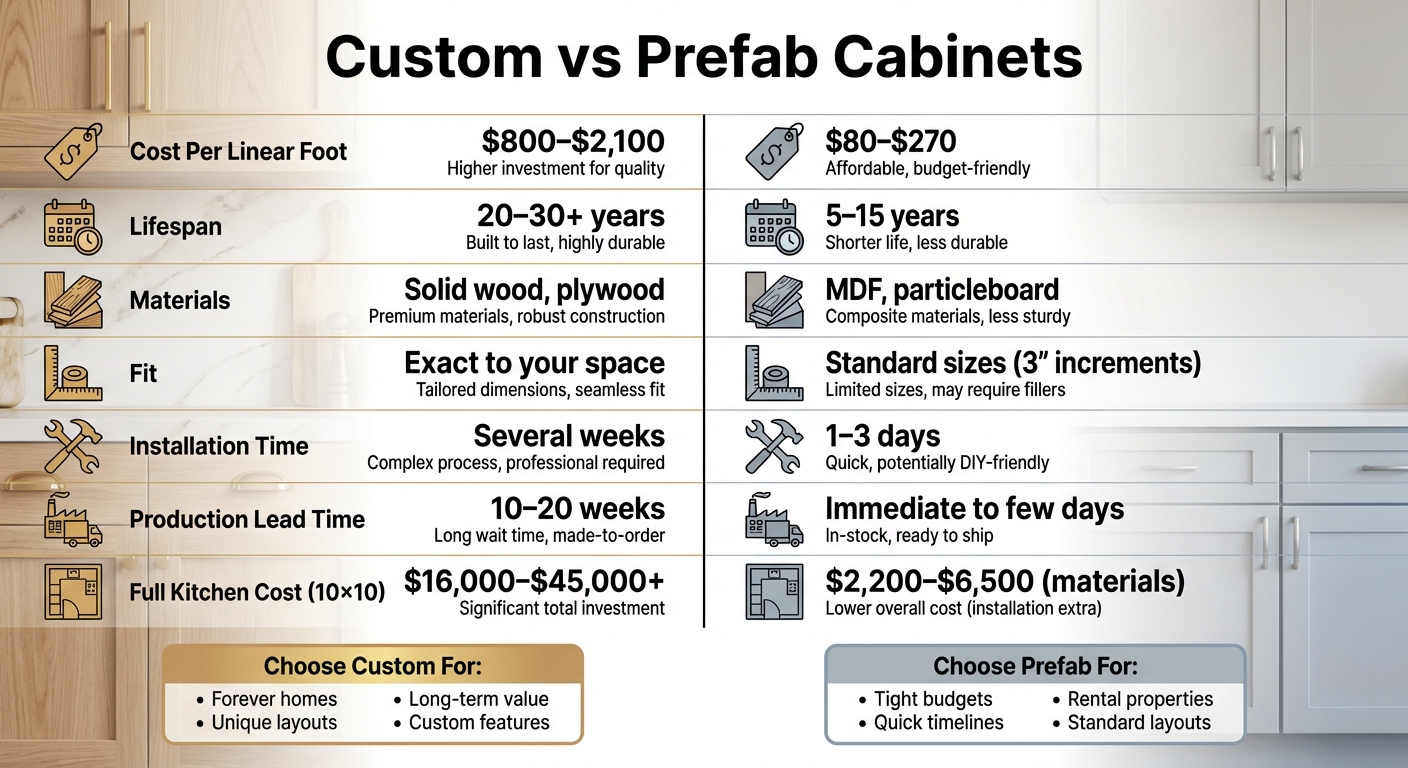
Custom vs Prefab Cabinets: Cost, Lifespan, and Features Comparison
The Ultimate Guide: Custom vs. Pre-Made Kitchen Cabinets
sbb-itb-cb01839
Design Flexibility Comparison
The key distinction between custom and prefab cabinets lies in how much control you have over the final design. With custom cabinets, every detail is tailored to your needs – down to fractions of an inch. You can select everything, from the type of wood to the interior configurations. Prefab cabinets, however, are mass-produced in standard sizes and finishes, offering a narrower range of popular styles like Shaker or raised panels. Let’s dive into the specific features that highlight these differences.
"Custom cabinets are made-to-order and crafted to fit your kitchen’s exact specifications. This level of customization allows for endless design possibilities."
– Mario Bulini, Alliance Millwork
Customization Options
Custom cabinets are ideal for homes with unique architectural quirks, such as slanted walls, odd angles, or exposed beams. For instance, if you have a 31-inch gap, a custom cabinet will fit that space perfectly. Prefab cabinets, on the other hand, come in standard 3-inch width increments (e.g., 12", 15", 18", 21", etc.). This means a 31-inch space would likely require a 30-inch cabinet with filler strips, leaving some wasted space. For older homes in areas like Toronto or Mississauga, where room layouts often stray from modern standards, custom cabinets can make a world of difference by maximizing storage and minimizing unused areas.
Custom cabinetry also allows for functional personalization. Whether it’s a pull-out stand mixer lift, an integrated charging station, or extra-deep drawers for heavy cookware, these features cater to specific needs that prefab cabinets simply can’t accommodate.
Beyond functionality, the aesthetic possibilities further set custom and prefab cabinets apart.
Style and Finish Options
Custom cabinets open up a world of design possibilities. You can select any wood species, match paint colours to your exact sample, or create unique door profiles that reflect your personal style. For example, if you’re envisioning a matte navy finish to match your backsplash, custom cabinetry can make it happen.
"Custom allows for stain or paint matching, special edge profiles, and door styles made for your project."
– Sam Wiebe, Decor Cabinets
Prefab cabinets, however, are limited to what’s available in the manufacturer’s catalogue. While big-box home improvement stores carry prefab options – approximately 80% of them, according to estimates – these designs don’t offer the same freedom. This limitation can be especially frustrating if you’re trying to achieve a specific look or seamlessly match your home’s existing decor.
| Feature | Custom Cabinets | Prefab Cabinets |
|---|---|---|
| Sizing | Exact fit (to the fraction of an inch) | Standard 3-inch units |
| Layouts | Perfect for irregular angles and spaces | Best suited for standard rectangular rooms |
| Finishes | Unlimited – any colour or stain | Limited to manufacturer’s options |
| Storage | Includes tailored features (e.g., mixer lifts) | Standard shelving and drawers |
| Gaps/Fillers | Eliminated with precise fits | Often requires filler strips |
Quality and Durability Differences
The materials and construction techniques behind cabinets play a huge role in their lifespan and their ability to handle everyday use. Custom cabinets stand out for their use of solid hardwood and furniture-grade plywood, which offer both strength and resistance to moisture. On the other hand, prefab cabinets are typically made from medium-density fibreboard (MDF) or particleboard, covered with thermofoil or melamine. While this keeps costs down, it also makes them more vulnerable to water damage over time.
Custom cabinets also excel in craftsmanship. For example, their drawers often feature dovetail joints, widely recognized as the gold standard for durability. In contrast, prefab cabinets rely on staples or basic screws for assembly. The hardware is another area where custom options shine. Brands like Blum supply soft-close hinges and drawer slides designed to last for decades, whereas stock cabinets come with lower-quality hardware that wears out more quickly. These distinctions in materials and construction underscore the lasting value of custom cabinetry compared to prefab alternatives.
"To keep costs down, stock cabinets are commonly constructed from lower-grade materials like medium-density fibreboard (MDF) or particleboard boxes… these materials are more susceptible to water damage, chipping, and wear and tear."
– Kitchen Renovations Coquitlam
Materials Used
Custom cabinets are designed with longevity in mind, using materials that can withstand moisture and daily wear. Plywood boxes, for instance, resist moisture and swelling – essential qualities for kitchens in Canada. Solid wood frames and premium veneers not only enhance durability but also add a touch of elegance. Additionally, finishes applied either by hand or in a factory setting protect against fading and staining, ensuring the cabinets look great for years.
Prefab cabinets, however, are built with cost efficiency as the priority. They often feature thinner materials like particleboard or MDF, which, while lightweight and affordable, are highly sensitive to moisture. The coatings – usually thermofoil or melamine – can peel or chip over time, especially in high-use areas like drawer fronts and cabinet edges. In humid conditions, these materials are prone to warping, which can lead to structural issues sooner than expected.
This focus on robust materials and construction is why custom cabinets hold up better over the long term.
Expected Lifespan and Care
Thanks to their superior construction and materials, custom cabinets are built to last. With proper care, they typically endure 20 to 30 years, and in some cases, even up to 50 years. Their solid build and quality finishes also allow for refinishing or repairs, further extending their usability. Maintenance is straightforward – cleaning with mild soap and a soft cloth, along with occasional polishing, helps preserve their finish.
In contrast, prefab cabinets have a much shorter lifespan, usually lasting between 5 and 15 years. Once the MDF or particleboard begins to break down, refinishing is rarely an option. Maintenance is also more limited, as harsh cleaning products can damage the thin laminates or thermofoil surfaces, making gentle cleaning a necessity. These differences in durability and care significantly impact the overall cost and value of the investment.
| Feature | Custom Cabinets | Prefab Cabinets |
|---|---|---|
| Primary Materials | Solid hardwood, plywood | MDF, particleboard, melamine |
| Typical Lifespan | 20–30+ years | 5–15 years |
| Water Resistance | High (thanks to plywood) | Low (prone to swelling) |
| Joinery | Dovetail joints | Staples or basic screws |
| Refinishing Potential | High (can be refinished) | Low (hard to restore) |
Cost Breakdown
When deciding between custom and prefab cabinets, your budget plays a key role. The price difference between the two is considerable, and knowing how costs break down can help you make an informed choice for your kitchen. Custom cabinets are more expensive due to skilled craftsmanship, high-quality materials, and precise manufacturing. In contrast, prefab cabinets benefit from mass production and standardized designs, making them more affordable. Remember to set aside an additional CAD $1,000–$3,000 for installation, delivery, and system adjustments.
Material choices also impact costs significantly. For example, selecting plywood over particleboard can increase costs by 15–30%, but it adds durability and better moisture resistance. Similarly, a painted finish costs 10–15% more than a stained wood finish because of its labour-intensive eight-step application process. These decisions not only affect your upfront expenses but also influence the long-term value of your kitchen. Below, we outline the costs per linear foot and for a full kitchen project.
Price Per Linear Foot
Custom cabinets are priced at CAD $800–$2,100 per linear foot. This cost reflects the advanced craftsmanship involved, such as dovetail joinery and hand-applied finishes. Professional installation typically adds CAD $80–$150 per linear foot, accounting for 15–25% of the material cost.
Prefab cabinets, on the other hand, cost CAD $80–$270 per linear foot for standard units. These are usually made from MDF or particleboard, making them an affordable option, though they lack customisation. If you opt for Ready-to-Assemble (RTA) cabinets and handle the installation yourself, you could save CAD $2,000–$5,000 in labour costs.
Full Kitchen Project Costs
For a standard 3m × 3m (10×10) kitchen, prefab cabinets cost between CAD $2,200 and $6,500 for materials alone. Adding professional installation, which ranges from CAD $2,500 to $5,000, brings the total project cost to approximately CAD $4,700–$11,500. This makes prefab cabinets a practical choice for rental properties or homeowners working within a limited budget.
Custom cabinets for the same kitchen size range from CAD $16,000 to $45,000+, depending on the design and materials selected. When you include additional expenses like installation, demolition, and plumbing or electrical modifications, the total cost can easily exceed CAD $50,000. However, this investment often proves worthwhile. In Canada, kitchen remodels that prioritise high-quality cabinetry usually yield a 75–80% return on investment, and custom cabinetry can increase your home’s resale value by as much as 7%.
"A kitchen remodel focusing on quality cabinets typically yields a 75% to 80% return on investment (ROI) in Canada, according to appraisal data."
– rtadepot.ca
Installation Process and Timelines
The process for installing custom cabinets is more involved than for prefab cabinets. Custom cabinets require design consultations, precise measurements, and hand-crafted production, which naturally extends the timeline. Prefab cabinets, being mass-produced in standard sizes, are often ready for immediate delivery. These differences significantly affect not only delivery schedules but also the coordination with other trades like plumbers and electricians.
Production and Delivery Times
Custom cabinets typically take 10–20 weeks from order to installation. This timeline accounts for design revisions, material sourcing, and potential supply chain delays . Because each cabinet is crafted to exact specifications, measured down to the millimetre, it’s wise to add an extra month as a buffer for unforeseen changes or logistical hiccups. Additionally, coordinating with other trades like plumbers or countertop installers is crucial, as the extended timeline can lead to scheduling challenges.
On the other hand, prefab cabinets are much quicker. Around 80% of big-box stores keep prefab cabinets in stock, ready for immediate purchase. Delivery often takes just a few days, making them a practical choice for projects with tight deadlines.
"Prefabricated cabinets can be delivered and installed much quicker than custom cabinets, which is ideal for those on a tight timeline." – Mario Bulini, Alliance Millwork
For rental properties or situations where time is a priority, this quick turnaround can be a game-changer.
Once production timelines are established, the next step is understanding the installation process.
Installation Requirements
Installation further distinguishes custom cabinets from prefab options. For custom cabinets, certified cabinet installers are essential to ensure a precise fit, especially for unique layouts. Depending on the complexity of your kitchen, installation can take several days to weeks. However, the benefit of custom cabinets is their perfect fit – even in older homes with irregular wall dimensions.
Prefab cabinets, by contrast, offer a simpler installation process. Homeowners or general contractors can often handle the job . Once delivered, installation typically takes just 1–3 days. However, because prefab cabinets are made in standard sizes (usually in 3-inch increments), some adjustments may be needed to ensure they fit your space .
| Feature | Custom Cabinets | Prefab Cabinets |
|---|---|---|
| Production Lead Time | 10–20 weeks | Immediate to a few days |
| Installation Duration | Several days to weeks | 1–3 days |
| Installation Complexity | High; requires certified professionals | Low; homeowner or standard contractor |
| Fit Adjustments | Built to exact millimetre; no fillers needed | May require minor adjustments |
Which Option to Choose
Deciding between custom and prefab cabinets boils down to your space requirements, project timeline, and future plans for the home. Both options bring distinct advantages, depending on what you need. Building on the earlier discussion of design and construction differences, the decision ultimately hinges on your specific layout and goals.
When Custom Cabinets Make Sense
Custom cabinets are the go-to choice for homes with tricky layouts or for homeowners planning to stay long-term and wanting top-notch craftsmanship. If your kitchen has slanted walls, odd corners, or unique dimensions, custom cabinets eliminate the gaps and filler strips often seen with prefab options. For older homes with irregular layouts, they provide a seamless, tailored solution.
"Custom cabinets are for the homeowner building their ‘forever kitchen.’ They are a worthy investment for those with a passion for design, a home with a challenging layout, or anyone who values the highest level of quality." – Kitchen Renovations Coquitlam
These cabinets stand out for their high-quality materials and expert construction methods, such as dovetail joints and furniture-grade plywood. While the upfront cost is higher, the long-term value is undeniable. In fact, custom cabinets can boost your home’s value by up to 7%. They also allow for personalized features like built-in mixer lifts, pull-out pantries, or custom spice dividers, making every centimetre of storage count.
When Prefab Cabinets Make Sense
Prefab cabinets shine when you need a quick solution. Perfect for rental properties, temporary housing, or projects with tight timelines, they’re widely available – around 80% of big-box stores keep them in stock. Pricing typically ranges from $75 to $400 per linear foot, with overall project costs between $2,000 and $10,000.
These cabinets work best in kitchens with standard rectangular layouts and straight walls. Common sizes like 12", 15", 18", 24", 30", and 36" allow for straightforward installation without costly adjustments. While they may not match the durability of custom options, prefab cabinets are cost-effective and quick to install, making them ideal for short-term or budget-conscious projects.
"Budget cabinets that fall apart in five years aren’t cheaper than quality cabinets lasting twenty years." – JWQ Cabinetry
For those looking for a middle ground, semi-custom cabinets offer a balance. Used in 40% of home renovations, they provide more flexibility than standard prefab options, with adjustable dimensions and finishes, all while staying more affordable than full custom work. This makes them a practical choice for homeowners seeking a mix of affordability and customization.
Conclusion
When deciding between custom and prefabricated cabinets, it all boils down to your design needs, budget, and timeline. Custom cabinets offer a tailored fit and superior craftsmanship, with a lifespan of 20–30+ years. However, they come with a price tag of approximately CAD $800–$2,100 per linear foot. On the other hand, prefab cabinets are more budget-friendly, costing around CAD $80–$270 per linear foot. They’re readily available and quicker to install, but their lifespan is typically shorter, ranging from 5–15 years.
"The choice between custom and prefabricated cabinets depends on your circumstances and priorities." – Mario Bulini, Toronto Kitchen Cabinets Blog
Think about your home’s layout, your long-term goals, and your budget to determine the best fit for your project. Custom cabinets are ideal for spaces with unusual dimensions or irregular angles, as they eliminate gaps and filler strips, creating a seamless look. Meanwhile, prefab cabinets can be a practical choice for rental properties or projects with tight deadlines, offering a balance of cost and convenience.
At Alliance Millwork, we take pride in crafting high-quality custom cabinetry tailored to your unique space. Our skilled team is dedicated to making the most of every centimetre, blending functionality with style. Book a free consultation today to see how we can bring your dream kitchen to life.
FAQs
Are semi-custom cabinets a good middle option?
Semi-custom cabinets hit the sweet spot between fully custom and prefab options. They’re made in standard box sizes but offer flexibility in finishes, hardware, and layout. This means you can achieve a tailored look without the hefty price tag or extended wait time that comes with custom cabinetry. It’s a smart choice for anyone looking to combine style with practicality during a renovation.
What can I do to protect prefab cabinets from water damage?
To shield prefab cabinets from water damage, consider applying waterproof coatings such as polyurethane or water-resistant varnishes. These create a protective barrier against moisture. It’s also crucial to maintain proper ventilation in areas where these cabinets are installed.
Take care of spills right away – leaving water to sit can lead to damage over time. Regularly check and maintain appliances and water lines to catch any leaks before they become a problem.
For added protection, using a dehumidifier and keeping indoor humidity levels consistent can help minimize moisture, reducing the risk of damage to your cabinets.
How do I estimate how many linear feet of cabinets I need?
To figure out the linear feet of cabinets, start by measuring the length of each wall or space where cabinets will go. Use inches for accuracy, but skip over areas where cabinets won’t be installed, like spots for appliances or windows. Once you’ve measured all the relevant sections, add those numbers together. Finally, divide the total by 12 to convert the measurement from inches to linear feet. This method gives you a solid estimate for the materials needed and helps with budgeting for the project.