
What Is Custom Millwork? A Complete Homeowner’s Guide
Custom millwork refers to wood-based interior elements like cabinets, shelves, trim, and panelling that are designed and crafted specifically to fit your home. Unlike mass-produced options, custom pieces are tailored to exact dimensions, offering a precise fit for unique spaces, awkward corners, or irregular layouts. These high-quality, durable solutions often use premium materials such as maple, oak, or walnut, and can include features like built-in storage, crown moulding, or custom vanities.
Key Benefits of Custom Millwork:
- Tailored Fit: Perfect for older homes or spaces with unusual dimensions.
- Durable Materials: Typically made from hardwoods or moisture-resistant options for longevity.
- Enhanced Functionality: Includes personalized features like pull-outs, hidden storage, or integrated lighting. These additions are particularly effective when designing a walk-in closet to maximize organization.
- Boosts Resale Value: Adds long-term value in competitive housing markets like Toronto and the GTA.
Cost Overview (Canada):
- Kitchen cabinets: $500–$2,000+ per linear foot.
- Custom closet systems: $2,500–$35,000+ depending on size and features.
- Bathroom vanities: $1,200+ per linear foot.
- Shelving and small built-ins: $3,000–$10,000.
Custom millwork is an investment in both style and functionality, especially in cities like Toronto where space optimization and high-quality finishes are highly valued. The process involves consultation, precise measurements, design renderings, fabrication, and professional installation, typically taking 4–12 weeks. While the upfront cost is higher than stock options, the longevity and tailored design make it a worthwhile choice for many homeowners.
How to design Custom Millwork | #lakestonelove
sbb-itb-cb01839
What Does Custom Millwork Mean?
Custom millwork refers to wood-based interior features like cabinetry, shelving, trim, and wall panelling that are specifically designed, crafted, and installed to fit your space perfectly. Unlike the mass-produced items you might pick up at a big-box store, these pieces are tailored to your exact dimensions, storage needs, and design preferences.
Millwork doesn’t include structural components like wall studs or floor joists. Instead, it covers the finished woodwork that adds personality to your space – think crown moulding, baseboards, mantels, door casings, built-in bookshelves, and custom kitchen cabinets. These elements are what bring a home’s interior to life.
The materials used in custom millwork vary depending on functionality and budget. Hardwoods like oak, maple, and walnut are popular for their strength and attractive grain, making them ideal for cabinetry. Softwoods like pine and cedar are often used for decorative trim, while engineered materials like MDF provide smooth surfaces that are perfect for painted finishes.
Custom millwork has several advantages. It makes the most of awkward spaces where standard products fall short, creates a unified look with matching wood finishes, and adds architectural detail that store-bought items can’t replicate. Whether you’re working with an oddly shaped wall in a historic home or maximizing storage in a small condo, custom millwork eliminates unsightly gaps and filler strips, delivering a seamless, built-in feel.
What Is Included in Custom Millwork?
Custom millwork encompasses woodwork crafted specifically to suit the dimensions and design of your home. Its versatility extends far beyond cabinetry, transforming spaces with tailored solutions. Kitchens benefit from customized storage, bathrooms gain perfectly sized vanities, and living rooms feature built-in shelving that maximizes space. Architectural touches like crown moulding, wainscoting, and door casings elevate plain walls, while custom closet systems, mudroom storage, and fireplace mantels combine functionality with aesthetic appeal. Let’s dive into the details of how custom millwork can enhance your home.
Custom Kitchen Cabinets
Kitchen cabinets are one of the most sought-after custom millwork projects. These are designed to fit your kitchen’s layout and needs, incorporating practical features like pantry pull-outs, built-in spice racks, and appliance panels for a sleek, unified look. Popular materials include hardwoods like oak, maple, and walnut, prized for their durability and natural beauty.
Modern touches – such as soft-close mechanisms, integrated LED lighting, and push-to-open hardware – combine practicality with a clean, minimalist style. Costs typically range from $500 to over $1,200 per linear foot, depending on the materials and level of detail.
Built-In Shelving and Wall Units
Built-in shelving offers a polished, cohesive look that freestanding furniture simply can’t achieve. These units are designed to fit snugly against walls, eliminating gaps and maximizing space. Common uses include bookcases flanking a fireplace, media units tailored to fit your TV, window seats with hidden storage, and home office desks integrated seamlessly into the room.
These custom solutions not only enhance aesthetics but also provide practical storage options tailored to your needs.
Bathroom Vanities
Custom bathroom vanities are especially useful in older homes with irregular layouts or in compact powder rooms where standard options fall short. You can specify everything from countertop height and sink placement to drawer configurations and storage features.
Often, these vanities are paired with matching millwork, such as decorative wainscoting or custom window casings, to create a unified design. Materials are typically chosen for their ability to withstand humidity, like moisture-resistant hardwoods or sealed finishes.
Closet Systems
Custom millwork shines in storage solutions, especially for closets. Walk-in closets can include adjustable shelving, built-in drawers, shoe racks, and perfectly positioned hanging rods. Even reach-in closets can benefit from clever layouts that make the most of the space. Mudroom systems are another popular application, offering designated spots for coats, boots, and bags to keep entryways tidy.
Costs for mid-sized installations generally range from $8,000 to $30,000, depending on the design and materials. For interiors, durable options like melamine are common, while thermofoil offers a low-maintenance finish for doors.
Architectural Trim and Wall Panelling
Architectural millwork provides those finishing details that define a home’s style. Crown moulding creates a seamless transition between walls and ceilings, while baseboards neatly complete the wall-to-floor junction. Door and window casings add elegance to openings, and chair rails bring character to hallways and dining rooms.
Wall panelling options range from wainscoting, which adds texture to lower wall sections, to full-wall treatments for a more formal appearance. These elements can be painted for a smooth finish or stained to highlight the wood’s natural grain. Pricing varies widely, with basic trim starting at around $500 per linear foot and intricate designs reaching $1,200 or more per linear foot.
Next, we’ll explore how these custom options compare to standard stock cabinets, showcasing their specific advantages.
Custom Millwork vs Stock Cabinets: What’s the Difference?
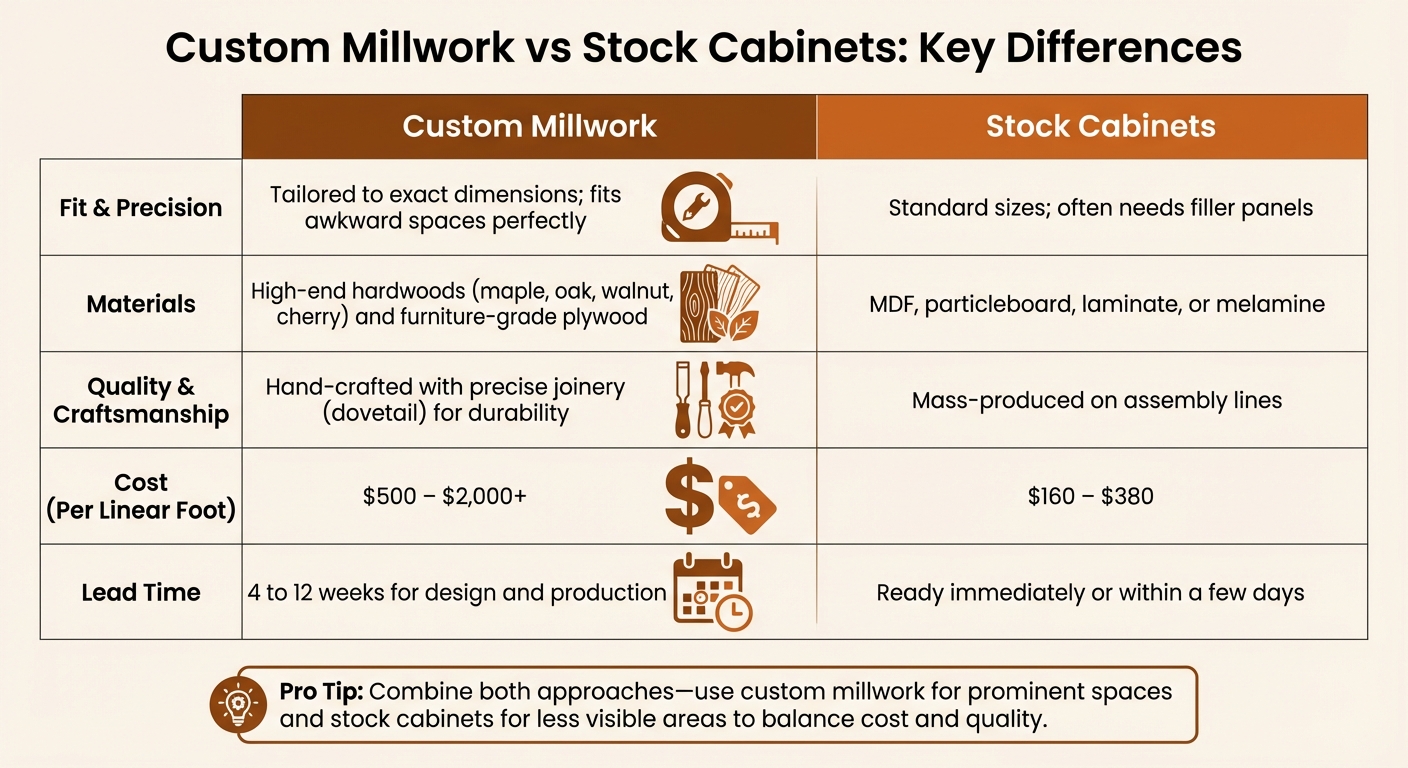
Custom Millwork vs Stock Cabinets: Cost, Quality & Timeline Comparison
Deciding between custom millwork and stock cabinets often comes down to how well they fit your space, the quality of materials, and your budget. Stock cabinets are mass-produced in standard sizes, which means they often require filler panels to fit into irregular spaces. On the other hand, custom millwork is crafted to your exact specifications, ensuring a seamless fit, even in tricky spots like sloped ceilings or tight corners. This tailored approach not only looks polished but also works harmoniously with unique architectural features.
The materials used are another key distinction. Custom millwork typically incorporates premium hardwoods like maple, oak, walnut, or cherry, paired with furniture-grade plywood. In contrast, stock cabinets are usually made from MDF, particleboard, and surfaces like laminate or melamine to keep costs down. These material differences influence durability – custom pieces are hand-crafted with methods like dovetail joinery, which enhance strength, while stock cabinets are assembled on automated production lines.
Mario Bulini from Alliance Millwork highlights this advantage:
"Custom cabinets, with their higher-quality materials and craftsmanship, are likely to last longer and withstand heavy use. If longevity and resilience are top priorities, custom cabinets might be the better investment".
| Feature | Custom Millwork | Stock Cabinets |
|---|---|---|
| Fit & Precision | Tailored to exact dimensions; fits awkward spaces | Standard sizes; often needs filler panels |
| Materials | High-end hardwoods and furniture-grade plywood | MDF, particleboard, laminate, or melamine |
| Quality | Hand-crafted with precise joinery for durability | Mass-produced on assembly lines |
| Cost (Linear Foot) | $500 – $2,000+ | $160 – $380 |
| Lead Time | 4 to 12 weeks for design and production | Ready immediately or within a few days |
These differences explain the higher upfront cost and longer lead time associated with custom millwork. For homeowners in Toronto and surrounding areas, custom cabinetry can be a smart investment. In high-value markets like Toronto and Mississauga, it not only elevates the home’s aesthetic and functionality but also boosts resale value. While custom millwork costs $500 to $2,000+ per linear foot compared to $160 to $380 for stock cabinets [3, 14], it’s a long-term investment that pays off in durability and timeless appeal. A practical tip? Combine the two – use custom millwork for prominent spaces and stock cabinets for less visible areas.
When soliciting quotes, ask whether the cabinet boxes are made from plywood or particleboard, as this will affect durability. Also, since custom projects involve detailed planning and manual craftsmanship, start the process at least three months before your target completion date [7, 3].
Benefits of Choosing Custom Millwork
Custom millwork is all about precision. It’s designed to fit perfectly into your space, accommodating everything from irregular corners to high ceilings and unconventional floor plans. Because each piece is tailored to your home, there’s no need for filler panels or awkward gaps. Even tricky areas – like the space under stairs or tight nooks – can be transformed into functional, efficient storage. For homeowners in Toronto and the GTA, especially those living in older homes with unique layouts, this personalized approach makes the most of every centimetre.
One of the standout features of custom millwork is its superior material quality. Unlike mass-produced options that often rely on particleboard or MDF with laminate finishes, custom millwork typically uses solid hardwoods like oak, maple, walnut, or cherry, paired with durable plywood construction. Many Canadian custom shops also prioritize environmentally friendly practices, using non-toxic, water-based finishes and locally sourced sustainable woods. These materials are not only better suited to Canada’s climate but also help reduce your environmental footprint.
"Custom millwork creates a sense of fluidity throughout the home while maximizing space and showcasing your individual tastes."
– Saville Custom Homes
Custom millwork doesn’t just fit your space – it integrates seamlessly with your home’s architectural design. Whether it’s matching existing mouldings, trim, or wood species, these bespoke pieces create a cohesive look that feels intentional and polished. In competitive real estate markets like Toronto and Mississauga, this level of detail can make a big difference, especially in high-value areas like kitchens and primary suites where buyers tend to focus their attention.
The practical advantages of custom millwork go far beyond its appearance. It allows for clever features like hidden appliance panels, push-to-open hardware, integrated LED lighting, and specialized storage solutions such as wine racks or spice pull-outs. Because the entire process – from design to installation – is handled in-house, the quality remains consistent, ensuring your investment stands the test of time. Unlike standard options that may need replacing within 10 to 15 years, custom millwork is built to last.
Of course, this level of craftsmanship comes at a cost, with prices typically ranging from $500 to $2,000+ per linear foot. But this one-time investment adds lasting value to your home. With its premium materials, expert craftsmanship, and tailored functionality, custom millwork isn’t just cabinetry – it’s a long-term upgrade to your living space. Next, discover how this attention to detail translates into a seamless custom millwork process.
How the Custom Millwork Process Works
The custom millwork journey starts with a free consultation to outline your vision, budget, and space requirements. This is your chance to share inspiration – whether it’s mood boards, sketches, or online ideas – to guide the design direction. At this stage, you’ll also receive a preliminary estimate that aligns with your budget. Many providers in the GTA, including those with workshops in Vaughan and Toronto, are known for offering upfront pricing, eliminating surprises down the line. Once the initial consultation wraps up, the process transitions to detailed measurements and design validation.
Next, the team visits your home to take precise measurements. These measurements consider everything from uneven corners to ceiling heights and existing architectural details. Using advanced CAD software, designers create technical drawings and 3D renderings to help you visualize the finished product. This step ensures you can see how the millwork will fit into your space, including details like colours, materials, and hardware, before production begins. Some companies may request a 5% design deposit at this stage, which is typically credited back when production starts.
Once you approve the 3D renderings, the fabrication process begins. With the design locked in, skilled craftspeople in local workshops bring the vision to life using carefully selected hardwoods and finishes. Premium workshops often use advanced techniques, such as multi-coat lacquer applications, to ensure the pieces are both durable and visually flawless. From start to finish, the entire process – design through installation – usually takes 4 to 12 weeks. Some companies even allow clients to visit their workshops during fabrication to see their pieces in progress.
The final phase is professional installation, where the same team that crafted your millwork delivers and installs each piece with precision. Installers carefully secure and level the pieces, adding finishing touches like trim and hardware. They also collaborate with other trades – such as electricians for integrated lighting or plumbers for sink installations – to ensure a seamless result. To wrap things up, a project manager conducts a final inspection, verifying that the work meets both your functional needs and aesthetic expectations before officially completing the project. This start-to-finish approach guarantees quality and consistency at every step, ensuring your custom millwork is built to last.
How Much Does Custom Millwork Cost in Canada?
Understanding the costs of custom millwork in Canada involves looking at several factors, including materials, design complexity, project size, and location. If you’re opting for hardwoods like maple, oak, walnut, or cherry, expect material costs to increase by 20–50% compared to alternatives like softwoods or MDF. Features such as integrated lighting, curved profiles, built-in organizers, or specialty hardware can also drive up both fabrication time and overall expenses. More intricate designs require additional skilled labour, which adds to the final bill.
In cities like Toronto and the GTA, prices tend to be higher. Custom millwork here can cost 15–25% more than the national average due to higher skilled labour rates, urban overhead, and logistical challenges. Labour shortages in Toronto have pushed rates up by 10–15% as of 2025, further increasing project costs. Even within the GTA, location matters – downtown Toronto projects may carry a 20–30% premium compared to areas like Mississauga or Burlington due to factors like parking and access difficulties.
Custom Millwork Pricing Examples
- Custom Kitchen Cabinets: Pricing for kitchen cabinets is usually calculated per linear foot. Basic designs start at $500–$750 per linear foot, mid-range options range from $750–$1,200, and high-end, intricate designs exceed $1,200–$2,000+ per linear foot. For a typical 20-foot kitchen, costs range from $10,000 to $30,000+ for fabrication and basic installation. In Toronto, luxury kitchen projects, including layout changes, high-end appliances, and custom cabinetry, can cost anywhere from $80,000 to $225,000. Mario Bulini from Alliance Millwork explains:
"Kitchen renovation costs in Toronto usually range from $15,000 to $45,000. However, the final price can vary depending on factors like the kitchen’s size, desired upgrades, materials, and appliance choices".
- Custom Closet Systems: Prices in Toronto range from $2,500 to $12,000. Reach-in closets (6–8 feet wide) cost $1,500–$4,500, while walk-in closets range from $3,500 to $15,000+ depending on size and luxury features. Boutique or room-sized closets can climb to $15,000–$35,000+.
- Bathroom Vanities: These are often priced similarly to high-end kitchen cabinetry, starting at $1,200+ per linear foot. The higher cost is due to the need for moisture-resistant materials and precise plumbing cutouts.
- Smaller Built-Ins: Items like shelving or accent walls typically cost between $3,000 and $10,000.
Additional Costs and Savings Tips
Professional services, such as detailed shop drawings and technical renderings, generally cost between $500 and $2,500+. These are especially useful for older Toronto homes with uneven walls, ensuring a precise fit. To save on costs, consider scheduling installations during the off-peak season (November to March), when prices are typically 10–15% lower. If you’re working on older homes in areas like East Toronto, it’s wise to set aside an extra 10–15% of your budget for unexpected structural issues or permit-related changes.
These details can help you gauge whether custom millwork is a worthwhile investment for your home, depending on your needs and location.
When Custom Millwork Is the Right Investment
Custom millwork is a smart choice when tackling tricky design challenges. For spaces like angled ceilings, narrow bedrooms, tight hallways, or awkward corners, standard cabinetry often leaves gaps or feels incomplete. Custom solutions not only address these issues but also enhance architectural details while offering long-lasting functionality.
In Toronto, unique home layouts often make custom millwork a necessity. Older houses in neighbourhoods like Leslieville, East York, and the Beaches frequently feature non-standard dimensions that stock cabinetry just can’t handle. Uneven walls, irregular ceiling heights, and quirky floor plans in these homes demand tailored solutions. And in a city where every square foot counts, custom built-ins maximize space and add practicality without sacrificing style.
High-traffic areas such as kitchens, mudrooms, and home offices especially benefit from the durability of custom millwork. Unlike mass-produced options that rely on MDF or particleboard, custom-crafted hardwoods stand up to wear and tear. This durability is particularly valuable in Toronto’s climate, where seasonal humidity can cause lower-quality materials to warp or break down more quickly.
Custom millwork also excels at creating a unified design throughout your home. Matching wood finishes from your entryway to your kitchen and living spaces creates a seamless, polished look that off-the-shelf cabinets simply can’t replicate.
For homeowners planning to stay put or aiming to boost resale value in Toronto’s competitive market, custom millwork is a worthwhile investment. It offers optimized storage, better functionality, and increased property value. While initial costs are typically two to three times higher, the precision craftsmanship and durability ensure it pays off in the long run. These benefits make custom millwork more than just a design choice – it’s a practical, long-term solution that ties directly into expert design and installation services.
Professional Design and Installation Services
When it comes to custom millwork projects, partnering with seasoned professionals can make all the difference. Companies that handle design, fabrication, and installation under one roof ensure consistent quality throughout the process. This streamlined approach eliminates the miscommunication that often happens when multiple contractors are involved, creating a smooth, stress-free experience from start to finish.
Many modern millwork providers rely on 3D rendering technology to bring your vision to life before production begins. With this tool, you can explore layouts, colours, and materials in detail, making adjustments before anything is manufactured. Alongside this, professional designers create precise shop drawings – technical blueprints that guarantee your millwork fits your space perfectly.
"At Alliance Millwork, we manage every stage – from concept development and 3D design to precision fabrication and professional installation."
Once the design is finalised, expert installation becomes the focus. Professional installers address real-world challenges like uneven walls or irregular ceiling heights – issues that technical plans might not fully capture. They ensure heavy units are securely supported with custom brackets, hardware is aligned correctly, and finishes complement your home’s architectural features. Alliance Millwork, for instance, provides services across the Greater Toronto Area, including Vaughan, Mississauga, Richmond Hill, and North York. Their local expertise allows for quicker consultations and tailored solutions.
In addition to millwork, many professional firms coordinate with other trades, such as electricians, plumbers, and flooring specialists. This level of coordination ensures that every detail aligns perfectly, extending the precision of the design phase to on-site execution. With comprehensive warranties and dedicated post-installation support, professional millwork services ensure your custom solutions remain functional and visually stunning for years to come.
Conclusion
Custom millwork redefines your home by blending functionality with architectural elegance. Whether it’s custom built-ins, meticulously crafted cabinetry, or tailored panelling that adds character, these solutions address both practical needs and aesthetic aspirations. Unlike off-the-shelf options, custom pieces are designed to fit seamlessly into your space, maximizing both utility and style [38,40].
The benefits of custom millwork extend far beyond its appearance. Homes with premium millwork often see higher resale values, thanks to the perceived luxury and craftsmanship they bring. From the initial design phase to installation, projects typically take four to eight weeks. And when crafted from durable hardwoods like oak or maple, these pieces can stand up to daily use for decades. Experts agree that millwork isn’t just a decorative addition – it’s a core element of architectural design.
To achieve the best results, partnering with skilled professionals is essential. Experienced craftsmen provide guidance on materials, create detailed shop drawings, and ensure precise installation. They handle challenges like uneven walls and work closely with other trades to ensure everything fits perfectly. This attention to detail ensures that the final product is not only functional but also built to last [3,5].
For Canadian homeowners, focusing on high-use areas like kitchens, living rooms, and bathrooms is a smart investment. Alliance Millwork’s comprehensive approach – covering design, fabrication, and installation – delivers both an enhanced living experience and long-term property value [3,17].
FAQs
Do I need permits for custom millwork?
Whether you need a permit for custom millwork largely depends on the specifics of your project. For instance, interior updates like installing cabinetry or wall panelling might require a building permit, particularly if the work involves structural changes, electrical wiring, or plumbing adjustments. Since regulations differ across Canada, it’s a good idea to check with your local building authority or consult a contractor to determine if a permit is necessary for your project.
What should I ask in a custom millwork quote?
When seeking a custom millwork quote, make sure to gather detailed information about the project. Ask about the specific wood types, finishes, hardware, and design elements included in the scope. It’s also important to clarify whether the quote covers materials, labour, and finishing work.
Don’t forget to discuss timelines – ask about lead times, installation schedules, and whether the process includes design consultations or revision rounds. Lastly, confirm if there are any additional charges for custom features or modifications. This way, you’ll know exactly what to expect and avoid any surprises.
How do I choose the best finish for my home?
Selecting the right finish for your custom millwork comes down to a few key factors: the purpose of the space, how much wear and tear it will endure, and the overall style of your home.
In areas with heavy use or high moisture – like kitchens and bathrooms – it’s smart to go with tough finishes such as polyurethane or lacquer. These finishes are designed to stand up to daily challenges like spills, humidity, and frequent cleaning.
If aesthetics are your main focus, you’ve got plenty of options. A natural stain can bring out the wood’s grain and texture, giving it a warm, classic feel. On the other hand, painted finishes are perfect if you’re aiming for a sleek, modern vibe.
To make sure you end up with a finish that balances durability and style, it’s always a good idea to consult a professional. They can help match the finish to your specific needs and design vision.