
Laminate vs Veneer vs Solid Wood: Pros and Cons
When choosing materials for cabinetry or furniture, you’ll often decide between laminate, wood veneer, and solid wood. Each has its own strengths, costs, and maintenance needs:
- Laminate: Durable, scratch-resistant, and budget-friendly. Great for high-traffic areas but cannot be refinished.
- Wood Veneer: Offers the look of real wood at a lower price. More vulnerable to scratches and moisture but can be lightly refinished.
- Solid Wood: Long-lasting and repairable, with unmatched natural beauty. However, it’s the most expensive and requires regular upkeep.
Quick Comparison
| Feature | Laminate | Wood Veneer | Solid Wood |
|---|---|---|---|
| Cost | $20–$50/m² | $50–$150/m² | $100–$300+/m² |
| Durability | High (scratch-resistant) | Moderate (vulnerable) | High (repairable) |
| Maintenance | Low | Moderate | High |
| Refinishing | Not possible | Limited | Multiple times |
| Appearance | Printed patterns | Natural wood grain | Unique natural grain |
Choose laminate for practicality, veneer for a balance of cost and aesthetics, and solid wood for premium, long-term use.
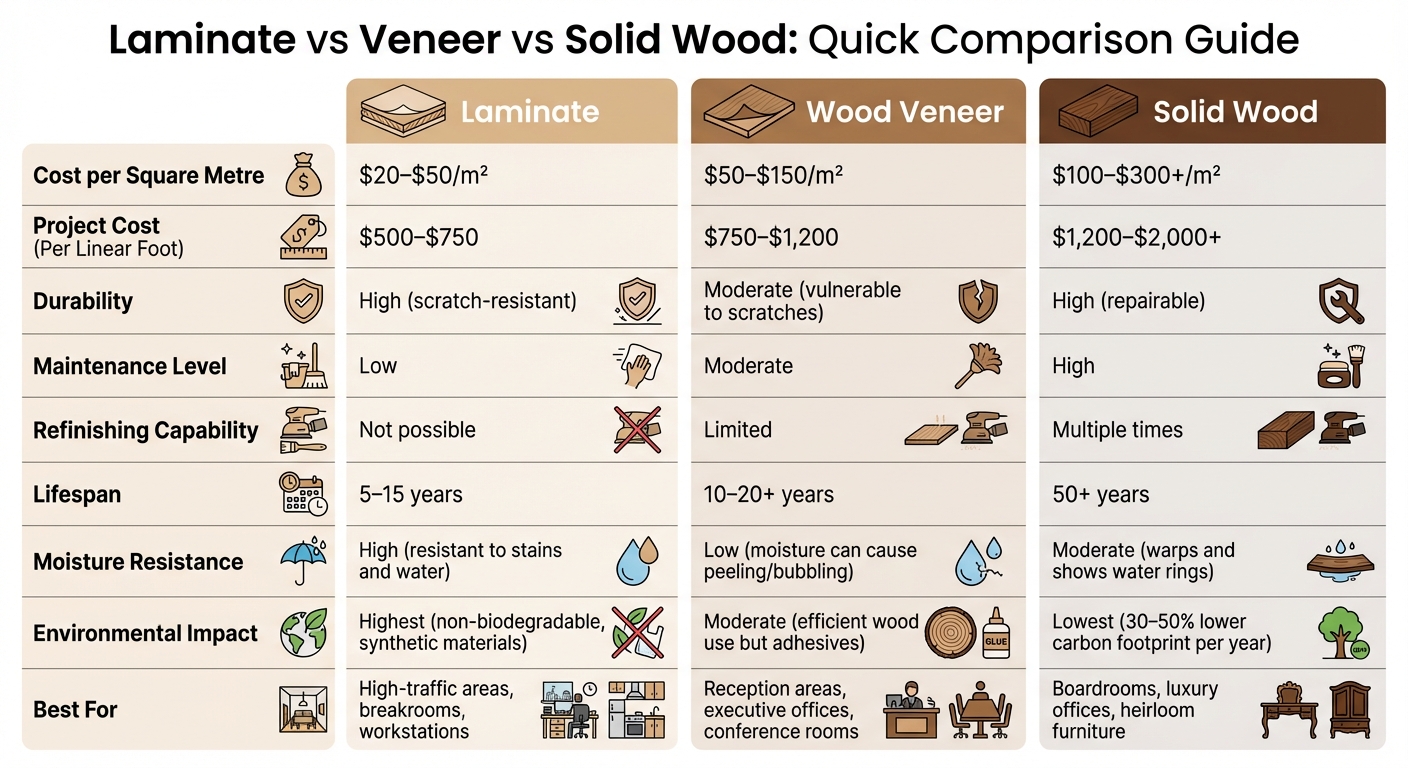
Laminate vs Veneer vs Solid Wood Comparison Chart
How To Tell If Furniture Is Laminate, Veneer or Solid Wood | Know Before You Flip Furniture
sbb-itb-cb01839
What Is Laminate?
Laminate is created by bonding heavy-duty paper or fabric with melamine resin, which hardens into a durable surface. This is then attached to a core material, such as particleboard, fibreboard, or MDF. Unlike solid wood or wood veneer, laminate uses printed decorative layers that replicate the appearance of wood, stone, or other patterns.
One drawback is that laminate cannot be sanded or refinished if it sustains deep damage; in such cases, the damaged panels usually need replacement. However, for projects that prioritise affordability, durability, and low maintenance, laminate remains a popular and practical choice.
Let’s take a closer look at how this versatile material is made.
How Laminate Is Manufactured
The manufacturing process for laminate involves pressing layers of kraft paper soaked in melamine resin under high heat and pressure, creating a rigid core. A decorative layer with a printed design is added on top, followed by a protective wear layer to guard against scratches and stains.
For High-Pressure Laminate (HPL), the process uses intense pressures between 1,000 and 1,500 psi and temperatures ranging from 138°C to 160°C. In contrast, Low-Pressure Laminate (LPL) – also called melamine or Thermally Fused Laminate (TFL) – is produced at lower pressures (290 to 435 psi) but higher temperatures (168°C to 191°C). This method bonds the decorative layer directly to the substrate using heat alone. Some laminates are enhanced with antibacterial or flame-retardant properties, making them ideal for healthcare settings or educational spaces.
Common Types of Laminate (HPL vs LPL)
Laminate is generally classified into two main types: High-Pressure Laminate (HPL) and Low-Pressure Laminate (LPL). The key differences lie in their construction and intended use. HPL, made from multiple layers of kraft paper bonded to a substrate, is highly durable and suited for heavy-use areas. LPL, with a single decorative layer, is thinner and better for vertical surfaces or areas with lighter wear.
| Feature | High-Pressure Laminate (HPL) | Low-Pressure Laminate (LPL/Melamine) |
|---|---|---|
| Construction | Multiple layers of kraft paper bonded to substrate | Single decorative layer bonded directly |
| Pressure | 1,000–1,500 psi | 290–435 psi |
| Temperature | 138°C–160°C | 168°C–191°C |
| Adhesives | Uses adhesives to bond layers | Relies on heat and pressure alone |
| Durability | Extremely resistant to chips and scratches | Moderately durable; suited for lighter use |
| Applications | Desktops, countertops, high-traffic areas | Cabinet interiors, shelving, casework |
HPL is typically used for horizontal surfaces like desks and countertops, where durability is a priority. LPL, being more cost-effective, is often chosen for vertical applications such as cabinet sides or shelving.
Where Laminate Is Used in Commercial Interiors
Thanks to its durability and low-maintenance properties, laminate is a go-to material for commercial spaces. It’s commonly used in office furniture like workstations, cubicles, open-plan desks, and conference tables. Retail environments also incorporate laminate in display fixtures, checkout counters, and shelving. Its resistance to scratches and stains makes it particularly well-suited for high-traffic areas.
Healthcare facilities, schools, and hospitality spaces often rely on laminate for surfaces that require frequent cleaning and sanitisation. Additionally, high-quality edge banding helps protect the material’s edges from moisture and impact, further extending its lifespan in demanding environments.
What Is Wood Veneer?
Wood veneer is a practical way to achieve the look of real wood without the hefty price tag, making it a popular choice for Canadian interiors. It’s made from thin slices of wood (0.5–1.5 mm thick) bonded to a stable core like MDF, plywood, or particleboard. Unlike laminate, which imitates wood with printed patterns, veneer showcases the natural grain, texture, and character of genuine wood.
This method not only delivers the aesthetic of solid wood at a lower cost but also offers better structural stability. The engineered core resists warping caused by humidity – something that often plagues large solid wood panels. Plus, veneer is a more resource-efficient option, as a single log can cover far more surface area when sliced into veneer sheets compared to being cut into solid boards. This makes it a smart choice for custom cabinetry and other projects where material conservation is a priority.
However, veneer isn’t without its challenges. It’s more susceptible to scratches and water damage than laminate. Moisture can seep beneath the glue line, causing bubbling or warping. The good news? Veneer can be lightly sanded and refinished with care if it gets scratched or stained.
How Veneer Is Produced
The process starts with slicing natural logs – often from species such as oak, walnut, maple, or ash – into thin sheets. To make cutting smoother and to enhance the wood’s grain patterns, logs are typically softened through steaming or soaking beforehand.
The way the wood is cut determines its appearance:
- Plain slicing creates the familiar "cathedral" grain pattern, often seen in cabinetry and furniture.
- Quarter slicing produces a straight, linear grain, perfect for sleek, modern designs.
- Rift cutting minimizes irregularities and is commonly used with oak to avoid "fleck" patterns.
- Rotary peeling generates bold, varied patterns, ideal for decorative panels.
Once sliced, the sheets are bonded to a core material using adhesives. The surface is then sanded, stained, and polished to achieve the final look. Because the veneer layer is so thin – typically around 3 mm – sanding must be done carefully to avoid exposing the core material.
This efficient use of wood allows a single log to cover a much larger area than solid boards would. Techniques like "book matching" (creating a mirror image by pairing two sheets) or "slip matching" (aligning sheets side by side for a repeating grain) further enhance its visual appeal.
Veneer Over MDF vs Plywood
The performance of veneered furniture depends heavily on the core material. Both MDF (Medium Density Fibreboard) and plywood are common choices, but each has its strengths and weaknesses.
- MDF offers a smooth, consistent surface that’s perfect for thin veneer applications. However, it’s heavy, prone to moisture damage, and may emit chemicals from its bonding resins.
- Plywood, made from layers of wood glued at 90° angles, is lighter and more durable. Its cross-grain construction resists warping, making it a stable choice [6, 10]. The downside? Plywood’s layered edges are visible and require edge banding for a polished look.
| Feature | MDF Core | Plywood Core |
|---|---|---|
| Stability | High (even density) | Very high (resists warping) |
| Weight | Very heavy | Moderate (lighter than MDF) |
| Moisture Resistance | Low (swells easily) | Moderate (better than MDF) |
| Surface Quality | Excellent (ultra-smooth) | Good (minor grain visibility) |
| Durability | Breaks easily if impacted | High structural integrity |
No matter the core material, high-quality edge banding is essential to protect against moisture and to keep the edges looking clean. Using coasters and desk pads on veneer surfaces can also help prevent scratches and water rings.
Typical Applications in Corporate and Hospitality Spaces
Wood veneer shines in corporate and hospitality settings where a polished, natural look is essential but solid wood isn’t practical. In executive offices, veneer is often used for desks, credenzas, and built-in cabinetry. Boardroom tables frequently feature book-matched veneer panels, showcasing symmetrical and striking grain patterns.
Reception areas and hotel lobbies also benefit from veneer’s warm, inviting aesthetic. You’ll often find it on wall panels, front desks, and concierge stations – areas where laminate just can’t compete. High-end hotel cabinetry, including in-room wardrobes and bathroom vanities, relies on veneer to maintain a cohesive and elegant design.
In conference rooms, private offices, and meeting spaces, veneer adds a touch of sophistication and professionalism. While it does require more maintenance than laminate – like regular dusting with a damp microfibre cloth and occasional polishing – its natural beauty and ability to be refinished make it a worthwhile investment, especially in spaces where first impressions matter.
What Is Solid Wood?
Solid wood is crafted entirely from natural timber. Unlike materials like laminate or veneer, it doesn’t rely on engineered cores, compressed fibres, or thin glued layers. It’s pure natural lumber through and through, showcasing its authentic grain, density, and strength.
One of its standout features is its continuous grain structure, which gives it exceptional load-bearing capacity. The fibres distribute weight evenly, making it incredibly durable. This full-density composition also allows for repeated sanding, refinishing, and repairs. With the right care, solid wood furniture can last anywhere from 20 to 50 years, often becoming cherished heirlooms passed down through generations.
However, solid wood is a living material. It reacts to its environment, expanding in humid conditions and contracting when it’s dry. This natural movement can sometimes lead to warping or cracking, particularly in large panels or areas with significant temperature swings. It’s also the priciest option, with costs varying depending on the wood species. Birch tends to be more affordable, while walnut and cherry are on the higher end of the price spectrum.
Common Hardwood Species Used in Millwork
In Canada, maple, birch, and oak are the go-to choices for solid wood in custom cabinetry and millwork due to their availability and ease of sourcing. Maple and birch are particularly favoured for painted finishes, as their smooth, "paint-grade" surfaces don’t reveal grain through the paint. Oak, with its coarse texture and bold grain, looks stunning when stained.
For more luxurious projects, walnut and cherry are top-tier options. Walnut stands out with its rich, dark tones and refined grain, while cherry develops a unique, deep colour that becomes even more striking with age. These species are less accessible, which places them at the premium end of the cost spectrum. Another noteworthy option is ash, often sourced through local urban lumber programs that repurpose wood from dead or diseased trees. This approach not only saves costs but also promotes a more sustainable use of resources.
Each of these species brings its own aesthetic and performance qualities, making solid wood a reliable choice for interior applications.
How Solid Wood Performs in Interior Environments
Solid wood is built to last. Its continuous grain fibres offer excellent resistance to bending under pressure and can handle long-term stress better than engineered materials. It also provides a secure hold for screws and nails, making it perfect for structural components like joints, legs, and frames. If the surface gets scratched or stained, it can be sanded and refinished to restore its original look.
That said, it does require some upkeep. Regular dusting with a damp cloth and occasional use of furniture polish, wax, or wood oils help maintain its shine and protect the surface. Moisture is its biggest enemy – spills should be cleaned up immediately to prevent permanent stains or fibre damage. In spaces with fluctuating humidity, solid wood may expand or contract, so maintaining stable indoor humidity levels is crucial to avoid issues like warping or cracking.
Structural vs Decorative Uses
Solid wood plays both structural and decorative roles in millwork. Structurally, its strength and ability to hold fasteners securely make it ideal for frames, legs, and joints – components that need to bear heavy loads reliably.
Decoratively, solid wood is prized for its natural beauty. It’s often used for cabinet doors, trim, and tabletops, where its grain patterns can shine. Over time, it develops a rich patina, adding character that improves with age. Techniques like distressing or wearing can create a rustic or antique look that veneers simply can’t replicate. In upscale settings like executive offices, boardrooms, or high-end cabinetry, solid wood offers a timeless elegance and durability that few materials can match.
Laminate vs Veneer vs Solid Wood: Key Differences
Here’s a quick breakdown of how laminate, veneer, and solid wood differ in terms of material makeup, appearance, and functionality. These distinctions influence not just how they look but also how they perform in everyday use.
Solid wood is crafted entirely from natural lumber, such as oak, walnut, or maple, without any additional materials. Wood veneer, on the other hand, is a thin slice of genuine wood – about 3 mm thick – adhered to a substrate like MDF or plywood using strong adhesives. Meanwhile, laminate is a synthetic option, made by layering kraft paper soaked in melamine resin with a decorative printed layer and a clear protective coating, all pressed together under high pressure.
Their appearances are equally distinct. Solid wood boasts natural, one-of-a-kind grain patterns that age beautifully, developing a patina over time. Veneer offers the beauty of real wood with the added versatility for intricate inlays and grain-matching designs. Laminate, however, provides a different kind of flexibility, with printed patterns that can mimic not just wood but also stone, metal, or bold colours, all with perfect uniformity.
When it comes to customisation, solid wood stands out because it can be sanded, stained, and refinished multiple times, making it a long-lasting option. Veneer, while offering some refinishing potential, is limited by its thin surface; sanding too deeply can damage it. Laminate, though not refinishable, makes up for this with a wide range of design choices.
Comparison Table
| Feature | Solid Wood | Wood Veneer | Laminate |
|---|---|---|---|
| Composition | 100% natural lumber | Thin wood slice (3 mm) over MDF/Plywood | Printed paper and resin over MDF/Particleboard |
| Appearance | Unique, natural grains that develop patina | Real wood grain with intricate inlay potential | Printed patterns mimicking wood, stone, or other textures |
| Customization | Can be sanded, stained, and refinished repeatedly | Limited refinishing due to thin wood layer | Cannot be refinished but offers diverse design options |
| Durability | Strong but can warp with humidity | Stable but prone to water damage at glue lines | Scratch-, stain-, and heat-resistant but not repairable |
Next, we’ll explore how these differences impact pricing in Canada.
Cost Comparison: Laminate vs Veneer vs Solid Wood in Canada
When budgeting for your project, understanding material costs is key. Here’s a breakdown of the costs for laminate, wood veneer, and solid wood in Canada.
Laminate is the most economical choice. Material costs range between $20 and $50 per square metre, and for full custom millwork, expect to pay $500 to $750 per linear foot. This makes laminate a popular option for budget-conscious projects.
Wood veneer falls in the middle price range. Material costs are typically $50 to $150 per square metre, with custom cabinetry priced between $750 and $1,200 per linear foot. The type of wood significantly impacts the cost – domestic species like birch or ash tend to be more affordable, while exotic options such as Kevazinga can exceed $80 per square metre.
Solid wood is the most expensive option. Material costs start at $100 per square metre and can exceed $300 for premium hardwoods. Custom millwork projects range from $1,200 to $2,000 or more per linear foot. According to Jatoba Kitchens and Millwork, "Hardwoods like maple, oak, walnut, or cherry can add 20–50% or more to your material cost because the raw material is pricier and harder to work with."
These prices generally include material and fabrication costs. However, additional expenses, such as professional shop drawings, can range from $500 to $2,500, depending on the project’s complexity. Keep in mind that in cities like Toronto, higher demand for skilled craftsmanship often leads to increased costs.
Pricing Table
| Material Type | Material Cost (Per Sq. Metre) | Project Cost (Per Linear Foot) | Best Budget Strategy |
|---|---|---|---|
| Laminate | $20 – $50 | $500 – $750 | High-traffic areas, base cabinets, rental units |
| Wood Veneer | $50 – $150 | $750 – $1,200 | Upper cabinets, reception areas, executive offices |
| Solid Wood | $100 – $300+ | $1,200 – $2,000+ | Focal pieces, architectural trim, heirloom furniture |
The next section will focus on durability and maintenance, helping you make a well-rounded decision for your project.
Durability and Maintenance Comparison
The durability of materials depends heavily on their resistance to wear and tear, as well as environmental factors. Laminate stands out as the most scratch-resistant option, thanks to its resin-infused protective layer. This makes it an excellent choice for high-traffic commercial spaces like retail counters or waiting rooms. Its hard surface is created by bonding under high pressure and heat, ensuring long-lasting performance.
While laminate is easy to maintain, solid wood offers a different balance of durability and repairability. Known for its structural strength, solid wood can last for generations but is prone to scratches, dents, and moisture-related warping. The upside? It’s highly repairable. As Greg Pilotti Furniture Makers explains, "Solid wood is durable, so if the surface gets scratched or stained, you can always repair it. You can completely refinish a tabletop by sanding, staining and sealing it". However, solid wood does need regular care, including oiling or waxing, to prevent drying and cracking.
Wood veneer, on the other hand, offers an authentic wood surface but comes with its own vulnerabilities. Veneer consists of a thin layer of wood – usually between 0.5 mm and 1.5 mm thick – making it more susceptible to deep scratches and damage from moisture. If moisture seeps under the veneer, it can loosen the adhesive, leading to bubbling or peeling. Amy Blitchok from BTOD.com highlights this issue: "Because veneer is glued to the core materials, it is possible for moisture to seep under the veneer and loosen the top layer. This can result in buckling and bubbles". Veneer can be lightly sanded and refinished, but sanding must be done carefully to avoid damaging the thin surface.
When it comes to maintenance, laminate is the easiest to care for – just a quick wipe with a damp cloth will do. Veneer and solid wood, however, require more attention. Both need periodic polishing and preventative measures like using coasters or desk pads to protect against water rings and scratches. In environments like healthcare or schools, where frequent disinfecting is necessary, laminate is particularly advantageous because it can handle harsh chemical cleaners without damage.
Understanding these differences is essential when choosing materials for various commercial applications. The table below provides a quick comparison of durability and maintenance for laminate, veneer, and solid wood.
Durability Table
| Material | Scratch Resistance | Moisture Tolerance | Refinishing Options | Maintenance Requirements |
|---|---|---|---|---|
| Laminate | Excellent; resists impact and abrasion | High; resistant to stains and water | None; cannot be sanded or stained | Low; easy cleaning with a damp cloth |
| Wood Veneer | Poor; prone to scratches and dents | Low; moisture can cause peeling/bubbling | Limited; can be lightly sanded/refinished | Moderate; dusting and occasional polishing |
| Solid Wood | Moderate; prone to dings but repairable | Moderate; warps and shows water rings | Excellent; can be sanded and refinished | High; requires oiling, waxing, and polishing |
Which Material Is Best for Commercial Projects?
Picking the right material for commercial furniture comes down to where it will be used and how much wear and tear it needs to handle. Solid wood, for instance, is usually reserved for high-end, prestige-focused spaces, while laminate and veneer are more common for everyday use. High-pressure laminate (HPL) stands out in high-traffic areas like open-plan offices, breakrooms, and healthcare settings. Its scratch-, stain-, and impact-resistant surface – created through high-pressure manufacturing – makes it a go-to for spaces where durability and easy cleaning are priorities. Plus, it can handle standard disinfectants without any trouble.
"Some project types, like healthcare and K-12, must prioritize cleanability, making plastic laminate the most logical choice" – Amy Guhl, Neumann Monson Architects
While laminate is practical for busy areas, veneer is better suited for spaces where aesthetics matter. Veneer brings the warmth and elegance of real wood to client-facing areas like reception desks, manager offices, and conference rooms. It’s a more affordable alternative to solid wood, but because it’s a thin layer, it’s not as tough – it can chip or suffer water damage in areas prone to spills.
Solid wood, on the other hand, is rarely used for commercial cabinetry projects due to its cost, weight, and tendency to warp in changing conditions. However, in spaces like executive suites, boardrooms, or luxury private offices where making an impression is key, solid wood is unmatched. It can last over 25 years because it can be refinished multiple times, making it a long-term investment.
Here’s a quick breakdown of how these materials perform in different commercial environments:
Commercial Applications Table
| Environment | Recommended Material | Primary Reason | Maintenance Level |
|---|---|---|---|
| General Workstations | Laminate (HPL) | Durable and cost-effective for large-scale use | Low: Easy cleaning with disinfectants |
| Reception Areas | Wood Veneer | Offers a premium, authentic wood appearance for first impressions | Moderate: Requires gentle cleaning and wood-safe products |
| Executive Offices | Wood Veneer or Solid Wood | Projects authority and sophistication while offering long-term value | Moderate to High: Needs polishing and refinishing |
| Breakrooms/Kitchenettes | Laminate | Excellent resistance to moisture and stains in food prep areas | Low: Simple wipe-down maintenance |
| High-Traffic Corridors | Laminate | Stands up to impacts and heavy use | Low: Easy cleaning with soap and water |
| Boardrooms | Solid Wood | Long-term investment with the ability to restore like-new condition | High: Requires regular polishing |
This table serves as a handy guide to help you choose the best material for your project based on the setting and requirements.
Environmental and Sustainability Considerations
When it comes to sustainability, solid wood stands out as the top choice. As a natural material, it breaks down more easily in the environment compared to engineered products and doesn’t rely on synthetic adhesives or chemicals. It’s also a carbon storage powerhouse – one cubic metre of wood can store roughly 1 tonne of CO₂ equivalent throughout its lifetime. With a lifespan exceeding 50 years and the ability to be refinished repeatedly, solid wood’s annual carbon footprint is 30–50% lower than that of furniture made with particleboard. While solid wood excels in eco-friendliness, wood veneer offers a middle ground, balancing resource efficiency with some practical limitations.
Wood veneer, made by layering thin slices of wood over a composite core, maximizes the use of natural wood. In Canada, the Formaldehyde Emissions from Composite Wood Products Regulations (CANFER) – enforced as of 7 January 2023 – sets strict limits on emissions (0.05 ppm for laminated products and 0.11 ppm for MDF), ensuring better indoor air quality. However, veneer products still pose challenges at the end of their life cycle, as their bonded construction complicates recycling.
On the other hand, laminate is the least eco-friendly option. It relies heavily on synthetic resins and adhesives, making it non-biodegradable. Manufacturing the particleboard core used in most laminates consumes 25–40% more energy than processing the same volume of solid wood, due to the high heat and pressure required to cure the resins. When laminate products reach the end of their lifespan, they almost always end up in landfills.
"Plastic laminate is also the least natural and least sustainable of the three options. The MDF substrate contains chemicals and adhesives, and when laminate reaches the end of its life cycle, it is likely to end up in a landfill."
- Amy Guhl, Neumann Monson Architects
For those prioritizing sustainability, choosing solid wood from FSC (Forest Stewardship Council) or PEFC (Programme for the Endorsement of Forest Certification) certified suppliers – or sourcing from urban lumber programs – can further reduce environmental impacts by cutting down on transportation emissions. These considerations, alongside cost and performance, play a critical role in selecting the right material for any project.
Sustainability Table
| Material | Renewable Resource Use | Recycling & Disposal | Environmental Impact | Typical Lifespan |
|---|---|---|---|---|
| Solid Wood | High (natural timber) | Biodegradable; highly recyclable and reusable | Lowest: 30–50% lower carbon footprint per year of use | 50+ years |
| Wood Veneer | Moderate (thin wood layer + core) | Difficult to recycle due to bonding adhesives | Moderate: Efficient use of wood but relies on adhesives | 10–20+ years |
| Laminate | Low (paper and synthetic resins) | Non-biodegradable; typically ends up in landfills | Highest: Involves synthetic chemicals and higher energy use | 5–15 years |
How to Choose the Right Material for Your Project
Selecting the right material for your project boils down to usage, maintenance needs, and lifespan. Start by considering how the space will be used. High-traffic areas like workstations, breakrooms, or classrooms benefit from laminate due to its resistance to scratches and stains. On the other hand, client-facing spaces, such as reception desks or executive offices, often warrant the elegance of veneer or solid wood for their genuine appearance. As Cory Porteous, Marketing Manager at Office Interiors, puts it:
Budget is another critical factor. Laminate is the most economical choice, offering durability at a lower price point. Veneer provides the look of real wood without the hefty price tag, while solid wood, though more expensive, can be refinished to last for decades. To balance cost and aesthetics, consider mixing materials – like pairing a solid wood boardroom table with laminate shelving for practicality and style.
Maintenance requirements should also guide your decision. Laminate is incredibly low-maintenance, needing only a damp cloth for cleaning, making it ideal for areas prone to spills, such as healthcare facilities or schools. Veneer and solid wood, however, demand more care – like using coasters, regular dusting, and occasional conditioning. Both laminate and veneer, when applied to stable MDF cores, can resist humidity and temperature changes.
Durability and repairability are equally important. Solid wood stands out here, as it can be sanded and refinished for over 50 years, with many products offering a 10+ year guarantee. Veneer allows for light sanding but has limits – excessive refinishing risks exposing the underlying core. Laminate, while durable, cannot be refinished; deep damage often means replacing the entire panel. If your project involves architectural curves or intricate designs, timber veneer is a great choice, as its thin slices can bend into shapes that solid wood cannot achieve.
Finally, don’t confuse weight with quality. A heavy MDF core doesn’t equate to natural timber. Always inspect the substrate – plywood cores are more stable and water-resistant than lower-quality particleboard. For healthcare or education settings where hygiene is a top priority, laminate’s ability to withstand chemical disinfectants makes it the most practical option.
Conclusion
As outlined earlier, each material comes with its own strengths and limitations. Laminate stands out for its durability and cost-effectiveness. It resists scratches, stains, and moisture, making it a practical choice for high-traffic areas like workstations or healthcare spaces. However, once damaged, it cannot be repaired and is the least environmentally friendly option. Wood veneer, on the other hand, offers the look of real wood at a mid-range price, making it ideal for reception spaces or executive offices. That said, it’s more susceptible to water damage and peeling, with limited refinishing options. Solid wood is unmatched for its longevity, as it can be refinished multiple times and last for generations. However, it comes with a higher upfront cost, requires more maintenance, and is prone to warping due to humidity – a critical factor in Canada’s fluctuating climate.
Combining materials can be a smart way to balance functionality and aesthetics. Laminate works well in areas where durability and ease of cleaning are essential. Veneer delivers a polished look without the expense of solid wood, while solid wood is perfect for standout pieces designed to last for decades. Selecting the right material involves carefully evaluating durability, appearance, and long-term value – factoring in traffic levels, maintenance needs, and budget – to ensure your choice aligns with your project’s specific goals.
FAQs
How can I tell if something is veneer or solid wood?
To tell the difference between veneer and solid wood, take a close look at the edges or underside of the piece. Veneer typically has a thin layer of wood glued over a core material like MDF or plywood, while solid wood shows a continuous grain pattern throughout. Veneer often feels smoother and more consistent, though it can chip along the edges. Solid wood, on the other hand, usually has natural variations in texture and grain, and any damage will affect the entire piece. You can also check labels or product descriptions for confirmation about the material.
What’s the best countertop material: HPL, veneer, or solid wood?
The ideal countertop material hinges on what you prioritize: durability, style, or budget. HPL (laminate) is a practical choice for high-traffic areas. It’s tough, easy to maintain, and stands up well against scratches, heat, and moisture. Veneer, on the other hand, gives you the look of natural wood without the hefty price tag, though it’s more prone to wear and tear. If you’re after a classic, high-end feel, solid wood is hard to beat. It can be refinished to maintain its charm, but it does come with a higher price and demands regular care.
Which option has the lowest VOCs for indoor air quality in Canada?
When it comes to indoor air quality in Canada, wood veneer stands out as the option with the lowest VOC (volatile organic compound) emissions. Veneer is created by applying a thin layer of real wood onto substrates like MDF (medium-density fibreboard) or plywood. This process typically involves fewer chemical emissions compared to alternatives.
On the other hand, laminate – constructed from synthetic materials – often releases higher levels of VOCs, especially when adhesives are part of the production process. Solid wood can also contribute to VOC emissions, largely depending on the type of finish applied. However, veneer remains a more environmentally conscious choice, offering a balance of natural aesthetics and reduced impact on indoor air quality.