
Top 10 Mistakes When Ordering Kitchen Cabinets
When ordering kitchen cabinets, common mistakes can lead to frustration, extra costs, and reduced functionality. Here’s what you need to avoid:
- Measurement Errors: Even small inaccuracies can throw off installation.
- Choosing Price Over Quality: Cheap materials often fail in durability and performance.
- Ignoring Material Differences: Not all materials handle moisture or wear equally.
- Poor Layout Planning: A bad layout disrupts workflow and wastes space.
- Overlooking Daily Usage: Cabinets should fit your cooking habits and storage needs.
- Skipping Quality Hardware: Low-quality hinges and pulls lead to frequent repairs.
- Neglecting Cabinet Lighting: Poor lighting makes storage impractical.
- Following Trends Blindly: Trendy designs age quickly and often lack practicality.
- Hiring the Wrong Contractor: Poor installation can void warranties and cause damage.
- Not Planning for Maintenance: Cabinets need regular care to extend their lifespan.
Key Takeaway: Focus on precise measurements, durable materials, practical layouts, and professional installation to ensure your kitchen cabinets are functional, long-lasting, and frustration-free.
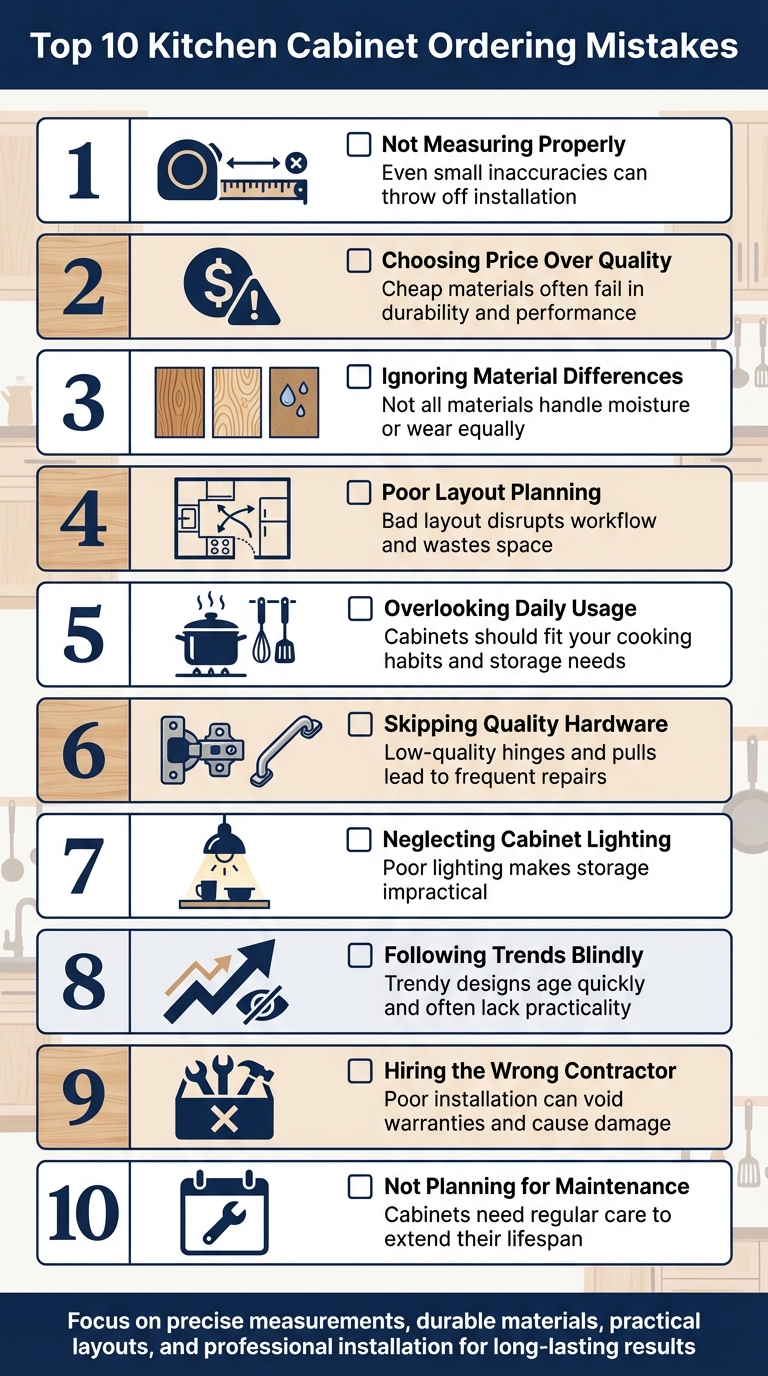
Top 10 Kitchen Cabinet Ordering Mistakes to Avoid
4 Kitchen Cabinet Mistakes Almost Everyone Makes
sbb-itb-cb01839
Why Choosing the Right Kitchen Cabinets Matters
Kitchen cabinets do more than just store your dishes – they play a key role in how efficiently your kitchen functions. They directly influence the flow of your work triangle (the area between the sink, stove, and refrigerator) and help create zones that make meal prep smoother. As Sarah Walker, Principal Designer and Owner of Nuance Interior Design Showroom, explains:
"The design of cabinetry throughout the home goes well beyond the shape and colour of the doors – it delves into the functionality of each room and what will be stored there."
Thoughtful cabinet design doesn’t just make your daily tasks easier; it can transform how your entire kitchen performs.
The impact of well-planned storage is backed by research. For instance, visual clutter can reduce focus by up to 15%, which can be a real challenge when you’re juggling multiple tasks in the kitchen. On top of that, the average person spends around 10 minutes a day searching for misplaced items. Over time, that adds up to hours of unnecessary frustration. Smart storage solutions can maximize cabinet space, helping you stay organized without needing to expand your kitchen’s footprint.
There’s also a financial side to consider. Kitchen cabinets are a major investment, and minor updates – like improving storage or upgrading materials – can recoup 70–80% of their cost when it comes time to sell. In open-concept homes, which are increasingly popular in Canada, your cabinets don’t just serve the kitchen; they’re a central design feature that needs to complement your entire living space. Beyond looks, durable hardware like quality hinges and slides ensures your cabinets perform well for years to come.
Walker highlights the broader benefits:
"Organised cabinets are an essential tool for saving time, reducing stress and creating harmony in our living spaces."
With properly designed cabinets, you can see what you have at a glance, avoiding duplicate purchases or expired food hiding at the back of a shelf. It’s an investment that simplifies your life every single day.
What Homeowners Miss When Ordering Cabinets
When it comes to ordering kitchen cabinets, many homeowners focus heavily on how they look, often overlooking crucial details that impact their practicality and durability. Common missteps include neglecting material quality, poor layout planning, subpar hardware choices, and measurement errors. Let’s break down how these factors can derail your cabinet project.
Material choices: While it’s tempting to pick materials based on appearance alone, this approach can backfire. For instance, low-grade particle board doesn’t hold up well in humid kitchen conditions, leading to faster wear and tear. The construction style matters too. Inset cabinets, while visually appealing, can warp or misalign due to changes in humidity or house settling. Another overlooked detail? Opting for baseboard moulding instead of a recessed toe kick. Baseboards are more vulnerable to water damage and wear from regular mopping.
Layout planning: A well-thought-out layout is essential for a functional kitchen. Ignoring your cooking habits and workflow can result in awkward cabinet placements and insufficient storage for your needs. It’s not just about fitting cabinets into the space; it’s about ensuring they complement how you use the kitchen daily.
Hardware quality: Hardware may seem like a minor detail, but it plays a big role in how your cabinets function over time. Cheap hinges and pulls may save money upfront, but they often lead to noisy, unreliable operation. As GoldenHome Global points out:
"Cheap hinges and pulls can ruin the cabinet experience with squeaks, slams, and breakages".
Without features like soft-close mechanisms, cabinet doors can slam shut, causing unnecessary wear on the frames.
Inaccurate measurements: Even the best materials and layouts can fall short if your measurements are off. Overlooking wall irregularities or the placement of outlets can result in misaligned cabinets and costly installation headaches. Precision is non-negotiable when it comes to ensuring everything fits as it should.
Paying attention to these often-missed details can save you from future frustrations and help your cabinets deliver both style and function.
1. Not Measuring the Kitchen Space Properly
Getting your kitchen measurements wrong can lead to some serious headaches – and a hefty bill. Even a tiny mistake, like being off by a few millimetres, can throw off your entire cabinet installation. Gaps, misaligned cabinets, or the need for expensive adjustments are all potential outcomes. So, how do you avoid this?
First, remember that walls and ceilings are rarely perfectly straight or level. To account for this, measure your wall-to-wall dimensions at three different heights: at the countertop level, mid-wall, and near the ceiling. This will help you spot any irregularities. Don’t forget to note obstacles like outlets, pipes, or vents, and include window and door trim in your measurements. Precision is key – measure to within 3 millimetres (about 1/8 inch) and avoid rounding up or down.
The tools you use also matter. A retractable metal measuring tape is your best bet since cloth tapes can stretch and give inaccurate readings. If you’re measuring high areas, use a step ladder and get someone to assist you in keeping the tape straight. Double-check every measurement before finalising your cabinet order – just one wrong number can throw off the entire design.
If you’re feeling uncertain, it’s a smart idea to bring in professional installers to confirm your dimensions. While it might seem like an added expense, it’s far less costly than dealing with cabinets that don’t fit. Plus, mistakes during DIY measurements could lead to damage or even void your warranty. Spending a bit more upfront for expert advice can save you from a lot of frustration (and extra costs) later on.
2. Choosing Price Over Quality
Opting for the cheapest cabinets might seem like a smart way to cut costs, but it often leads to expensive headaches down the road. Cabinets made with low-quality materials and poor construction can quickly wear out, bringing unexpected repair or replacement costs.
The main culprit here is the material. Budget cabinets often rely on low-grade particle board, which struggles to hold up against the moisture and humidity that are common in kitchens. Paul McAlary, President of Main Line Kitchen Design, emphasizes the importance of prioritizing design and quality over price:
"The designer is THE most important part of the kitchen renovation process. Customers who prioritize price over design end up working with less transparent designers and end up either spending more or losing value in the end."
When you look closely, spending a little more upfront can make a big difference. For example, upgrading to plywood sides adds about 15% to the cost but significantly increases durability. Solid wood raised panel doors, which are about 15% pricier than veneers, are less prone to splitting in dry conditions. Similarly, choosing 3/4" shelving instead of 5/8" costs just 5–10% more but prevents sagging over time.
The finish is another area where quality matters. Standard paints may wear out quickly, but durable options like two-part conversion varnishes or oven-baked finishes can extend the life of your cabinets. If a finish starts to deteriorate within a year, you could face refinishing costs that easily outweigh your initial savings.
"Lower-priced cabinets may seem like a good deal at first. However, if they’re made with inferior materials or constructed poorly, you’ll end up paying more in the long run for repairs or replacements." – Legacy Cabinets
To avoid these pitfalls, consider investing in features like 3/4" plywood boxes, solid wood drawer boxes, soft-close hardware, and high-quality finishes. While these upgrades may cost more upfront, they ensure your kitchen can handle 20+ years of daily use without constant fixes. Spending a bit more now can save you from costly renovations later, giving you a kitchen that stands the test of time.
3. Ignoring Cabinet Material Differences
Not paying attention to the differences between cabinet materials is a common mistake. Each material – whether it’s solid wood, plywood, MDF, or particle board – reacts differently to moisture, temperature changes, and wear. This is especially important in Canada, where seasonal humidity changes can take a toll on poorly chosen materials. Here’s a closer look at how these materials perform in such conditions.
Solid wood is undeniably beautiful and can be refinished over time. However, in Canada’s climate, it expands and contracts with humidity changes, which can lead to warping or cracking. If you go with solid wood, maintaining consistent indoor humidity is crucial to keep your cabinets in good shape.
Plywood is a standout choice thanks to its cross-grain construction, which makes it resistant to warping. It performs well near sinks or dishwashers, where moisture exposure is higher. Its strength and moisture resistance make it a top choice for cabinet boxes. To ensure long-term durability, especially in areas where hinges and heavy hardware are attached, aim for cabinets made with at least 3/4-inch thick plywood or solid wood. This prevents screws from loosening or stripping over time.
MDF is a favourite for modern, painted cabinet doors because of its smooth and stable surface. However, it has a major downside: if moisture gets through its finish, it swells and cannot be repaired. For this reason, MDF is best kept away from areas with high moisture levels.
Particle board, while affordable, comes with significant drawbacks. It tends to sag under weight, doesn’t hold screws well, and falls apart quickly when exposed to moisture. It’s the least durable material and should be avoided in spots where strength and longevity are needed.
A smart approach is hybrid construction – using plywood for the cabinet boxes and MDF or solid wood for the doors. This combination strikes a balance between durability, aesthetics, and cost, making it a practical choice for Canada’s unpredictable climate.
4. Poor Layout and Storage Planning
A poorly designed cabinet layout can turn your kitchen into a daily source of frustration. Without considering how the space will function in real life, you risk wasting space, creating awkward access points, and disrupting the overall workflow. Let’s break down some common layout mistakes that can hinder your kitchen’s usability.
One major issue is obstruction and clearance problems. Poorly positioned doors and drawers can block one another or clash with appliance handles, especially in 90° corner layouts. To avoid this, ensure walkways are at least 91 cm (36 inches) wide. In high-traffic or seating areas, aim for 107–122 cm (42–48 inches) of clearance. Sheri Brown, a Kitchen & Bath Design Expert at Reico Kitchen & Bath, offers this advice:
"From the back of the kitchen island to a wall or other countertop area, I try for at least 48" of space. This is typically a main ‘traffic path’ and/or has seating. I caution going less than 48" in that scenario and encourage more, as much as 54" to 60" where space allows".
Another frequent mistake is failing to plan storage for small appliances. Items like toasters, mixers, and coffee makers can quickly take over your countertops – a problem often called “appliance creep”. Including storage solutions like appliance lift cabinets or larder cabinets with internal power outlets can help keep your counters clear. Also, don’t forget architectural details like window trim or door casings; without proper planning, cabinets may not open fully. Allow at least 7.6 cm (3 inches) of clearance between cabinetry and trim.
Ignoring the kitchen’s work triangle – the ideal distance between the sink, stove, and refrigerator – can lead to an inefficient workflow. To address this, consider specialized storage solutions such as pull-out shelves, swing-out cabinets, and lazy Susans to make hard-to-reach areas more accessible. Storing frequently used items at waist or eye level can also save time and effort, making your kitchen more functional.
Lastly, a poorly sized kitchen island can exacerbate layout issues. An oversized island can make the space feel cramped, while one that’s too small might lack sufficient storage or workspace. Ensure your island is proportionate to your kitchen and doesn’t obstruct traffic flow. Don’t forget to account for cabinet handle depth to prevent collisions.
5. Not Considering Daily Usage Needs
When designing your kitchen cabinets, it’s crucial to think beyond aesthetics and focus on how they’ll function in your day-to-day life. Cabinets should complement your cooking routine, not just look good. Many homeowners make the mistake of prioritizing style over practicality, which can lead to constant frustration during meal prep. As GoldenHome Global points out, "Kitchen cabinet design mistakes are not just aesthetic problems – they often lead to daily frustration, wasted space, and costly renovations".
One frequent misstep is placing storage too far from cooking zones, wasting time and disrupting workflow. GoldenHome Global stresses that "A well-designed kitchen cabinet layout should support the natural flow between prep, cooking, and cleaning zones". Take a close look at how you cook and organize your space accordingly. Placing frequently used items within easy reach can make a world of difference.
To further streamline your kitchen, avoid deep cabinets that make it hard to see or access items. Instead, opt for pull-out drawers, which are perfect for keeping cookware like cast iron pans or mixing bowls visible and easy to grab. This small adjustment can save time and reduce hassle, especially when dealing with heavier items.
If you have children or elderly family members, consider soft-close hinges to avoid pinched fingers and reduce wear and tear. Hardware is another detail that can either enhance or hinder your kitchen’s usability. As Classic Brand warns, "The wrong cabinet hardware selection will greatly impact your kitchen’s overall look and functioning. Poor hardware can make it difficult to use and ruin the overall design". Choose handles and pulls that are easy to grip, keeping accessibility in mind for everyone, including those with limited dexterity.
Lighting is another practical element often overlooked. Add under-cabinet and pantry lighting to make it easier to locate items, especially in deep storage spaces. Be mindful of finishes too; high-gloss surfaces may look sleek but tend to show fingerprints, which can be frustrating in a busy kitchen. When designing your cabinets, focus on how they’ll fit into your cooking routine rather than chasing fleeting trends. A well-thought-out design ensures your kitchen will meet your needs both now and in the years to come.
6. Skipping Soft-Close Hinges and Quality Hardware
When it comes to kitchen cabinets, the hardware you choose plays a huge role in their functionality and durability. While it might be tempting to cut costs by opting for cheaper hinges and pulls, this decision can lead to constant frustration and added repair costs. As GoldenHome Global puts it:
"Cheap hinges and pulls can ruin the cabinet experience with squeaks, slams, and breakages".
Low-quality hardware tends to wear out quickly. Hinges start squeaking, drawer slides may stick or wobble, and cabinet doors can slam shut with enough force to damage the frames over time. Handles and pulls made from lower-grade materials are also prone to breaking or loosening, requiring frequent adjustments or replacements.
The key difference between cheap and high-quality hardware lies in the materials and craftsmanship. Solid brass, bronze, or stainless steel hardware provides durability and a sturdy feel, while budget options often use lightweight zinc alloys or hollow designs that are prone to warping, corrosion, and failure. Investing in better hardware ensures your cabinets not only look good but also perform well for years to come.
Soft-close hinges are another worthwhile upgrade. They prevent doors and drawers from slamming, which not only reduces noise but also protects your cabinet frames from the repeated impacts that can loosen joints or damage panels. Considering that kitchen cabinets often account for over one-third of a remodelling budget, spending a little more on durable hardware is a smart way to protect your investment.
If you’re unsure about the quality of a hardware piece, its weight can be a good indicator. Heavier pieces are typically made from solid metal, signalling durability, while lightweight options often point to cheaper, hollow construction. Although quality hardware may cost more upfront, it often lasts for decades without needing replacement, unlike budget alternatives that may fail within just a few years.
Once you’ve chosen reliable hardware, you can focus on other details – like cabinet lighting – that further improve your kitchen’s usability.
7. Overlooking Lighting Inside Cabinets
Interior lighting can make or break the functionality of your cabinets. Without it, even high-end cabinetry can feel impractical. Deep pantries and upper cabinets often become "black holes", where items vanish into shadowy corners, making it tough to find what you need. Adding lighting isn’t just about aesthetics – it significantly improves usability.
When the back of your cabinets is poorly lit, it’s easy for items to get lost, which can disrupt your kitchen’s organization.
As RTI CABINETS highlights:
"In modern kitchen design, lighting inside cabinets is no longer optional – it is a sophisticated upgrade that enhances both function and style".
LED lighting has become a practical solution, offering long lifespans ranging from 20,000 to 50,000 hours. To achieve the best results, go for LED strips in a neutral white tone (3,500K to 4,000K) with 100 to 300 lumens per cabinet. Use diffusers to avoid visible hotspots, and consider motion sensors in pantry spaces for automatic activation. This way, your cabinets remain well-lit without unnecessary energy waste.
It’s smart to plan for lighting during the cabinet design stage. This allows wires to be hidden behind cabinet boxes and ensures a clean, integrated look. Place the lights near the front edge of the cabinet instead of the back to minimize shadows and provide even illumination across all your stored items.
8. Following Trends Instead of Long-Term Style
Kitchen cabinets are often one of the biggest expenses in a remodel, with costs frequently surpassing $10,000. While trendy designs can be tempting, they might leave your kitchen looking outdated in just a few years.
Design trends evolve quickly – what’s in today might be out tomorrow. For instance, all-white cabinets, once a favourite, are now falling out of favour, while honey oak, which was once unpopular, is making a surprising return.
The problem with trendy cabinets isn’t just about looks. Many of these designs sacrifice practicality for style, leading to long-term headaches. Take curved cabinets, for example: they may look sleek, but they reduce storage space and demand extra clearance. Similarly, inset cabinetry offers a high-end aesthetic but comes with trade-offs like higher costs, reduced storage, and potential issues with functionality. Samantha Arak, Founder of Samantha Carey Interiors, highlights this challenge:
"Because of the precision required for seamless drawer and door operation, the slightest out-of-level installation… can result in cabinetry rubbing where it shouldn’t. It’s the equivalent of chafing, but for cabinetry".
Opting for timeless designs ensures your investment remains practical and functional for years to come.
Trendy choices can also affect your home’s resale value. Potential buyers usually prefer "move-in ready" spaces, and bold colours or highly personalised features like cabinet cut-outs can signal extra work down the line. Kate Daskalakis, Founder and Principal of KSD Designs, puts it this way:
"I’ve been skeptical of cabinet cut-outs of flowers or mountains or other shapes… those look like you’re giving your cabinet a tattoo".
For a more enduring design, stick with neutral colours like white, off-white, light grey, or natural wood tones. Pair these with Shaker-style doors, known for their clean and classic lines, which never go out of style. If you want to incorporate trends, focus on elements that are easier to update, such as hardware, lighting, or backsplashes. These details can add a modern touch without locking you into a look that might age poorly. By prioritising timeless design, you can create a kitchen that remains both stylish and functional over the long term.
9. Hiring the Wrong Contractor or Supplier
Picking the wrong contractor for your cabinet project can quickly spiral into a costly disaster. Poor installation doesn’t just ruin the look of your cabinets – it can also lead to structural problems and even void your manufacturer’s warranty, leaving you with no backup for repairs.
One common error is failing to secure cabinets to wall studs. If heavy cabinetry is hung directly on drywall, it risks pulling away or even falling once loaded with dishes or cookware. Another frequent issue is improper levelling. If cabinets aren’t levelled in every direction, you could end up with uneven countertops or doors that refuse to close properly. As Classic Brand explains:
"The biggest advantage of working with professionals is that they know how to pace themselves. All of this has to be done right, so they take time checking their work, levelling the cabinets, and producing a top-grade installation".
This kind of precision is what ensures your cabinetry project comes together seamlessly.
To protect your investment, pay close attention during the hiring process. Be wary of contractors who rush through measurements, lack essential tools like laser levels or reliable stud finders, or can’t clearly explain how they’ll handle plumbing and electrical work. Before signing any agreement, confirm the contractor has proper licensing and insurance. Ask for a Certificate of Insurance that covers General Liability and Workers’ Compensation. It’s also smart to gather at least three written estimates and check references from past clients you trust.
Watch out for red flags like contractors asking for full payment upfront or offering bids that seem suspiciously low. A reasonable deposit is about one-third of the total project cost, with additional payments tied to specific milestones. Make sure your contract outlines the scope of work, includes a process for handling changes, and specifies firm start and completion dates.
Hiring professionals doesn’t just safeguard your financial investment – it also ensures safety and keeps your warranty intact. As GoldenHome advises:
"Improper installation can damage your cabinets and void warranties. Always hire professionals for best results".
10. Not Planning for Future Maintenance and Repairs
Taking care of your cabinets after installation is just as important as choosing the right design. Long-term upkeep protects your investment and ensures your cabinets last as long as possible.
Skipping regular maintenance can lead to expensive repairs and even shorten the lifespan of your cabinets. With consistent care, you can add an extra 3–5 years to their life expectancy. Generally, stock cabinets last around 15–20 years, while semi-custom or custom cabinets can last 20–25 years – but only if they’re well-maintained. Without a plan, you might end up replacing your cabinets far sooner than you’d like.
When ordering cabinets, it’s smart to opt for adjustable, durable hardware. This lets you tweak door alignment years down the line, avoiding problems like sagging doors or uneven gaps that could damage the cabinet faces. Also, think about the finish material – stained finishes are usually easier to repair with touch-up kits compared to some laminate options. Keeping a maintenance kit on hand (complete with a touch-up pen, fill stick, and matching putty) can help you quickly fix scratches and keep your cabinets looking great.
Regular cleaning habits make a big difference. Weekly spot cleaning prevents grease and dust from building up and wearing down the finish. Stick to mild soap and water – harsh chemicals like bleach or ammonia can damage the surface and shorten the lifespan of your cabinets. Once a year, take the time to do a deep clean, which might include removing the doors to clean hinges and hidden areas thoroughly. These small steps can go a long way in keeping your cabinets looking and functioning like new for years to come.
How to Avoid These Cabinet Mistakes
To steer clear of common cabinet installation errors, take a meticulous approach and double-check every detail before placing your order. A little extra effort upfront can save you time, money, and frustration later.
Start by measuring your kitchen space not once, but two or three times. This ensures precision and accounts for appliances, plumbing lines, and electrical outlets. Use a laser level to check if your walls are square and floors are even. If there are any irregularities, you may need to use shims to address them. These careful steps create a solid foundation for your project and align with earlier recommendations.
Another smart move? Consult a professional designer. These experts not only help you create a layout that suits your cooking habits and movement patterns but also use tools like stud finders to locate wall studs for secure cabinet anchoring. As Classic Brand explains:
"The biggest advantage of working with professionals is that they know how to pace themselves. All of this has to be done right, so they take time checking their work, levelling the cabinets, and producing a top-grade installation."
When it comes to materials and hardware, don’t skimp on quality. Choose cabinet boxes made from plywood rather than particleboard, and go for solid hardwoods like oak, maple, or cherry for doors and face frames. Invest in soft-close hinges and sturdy hardware to ensure long-term durability. For structural strength, make sure end panels and shelves are at least 1.27 cm (½ inch) thick.
Lastly, check for anything that might obstruct functionality. Ensure there’s enough clearance for doors and drawers to open fully. Opting for professional installation is a wise decision – it safeguards your manufacturer’s warranty and helps you avoid costly errors down the line.
Custom vs Stock Cabinets: Which Option Prevents Mistakes?
When it comes to avoiding cabinet ordering mistakes, the type of cabinets you choose can make a huge difference. Stock cabinets are built in fixed increments of 7.6 cm (3 inches), meaning they often require fillers and spacers to bridge gaps. This can leave you with wasted space and an unfinished look that detracts from your kitchen’s design. On the other hand, custom cabinets from Alliance Millwork are designed to fit your kitchen’s exact measurements, making every centimetre count and eliminating the need for awkward patches.
Another key difference lies in the materials. Stock cabinets are typically made from particleboard or MDF, which are cost-effective but prone to warping or swelling when exposed to moisture – a common issue in kitchens. Custom cabinets, however, use premium materials like plywood boxes and solid wood doors, ensuring durability and resistance to damage. These high-quality components mean custom cabinets can last 20–30 years with proper care. As Viktoriia Hohunska from Corner Renovation explains:
"Custom cabinetry is about fitting the room you actually have… and creating a cleaner, more integrated look that does not rely on fillers and compromises."
Cost is another factor to consider. Stock cabinets are priced between $80 and $300 per linear foot, with total kitchen costs ranging from $5,000 to $15,000. Custom cabinets, by contrast, range from $500 to $1,500+ per linear foot, bringing total costs to $20,000–$45,000 or more. While the upfront cost of custom cabinets is higher, their durability and tailored fit often make them a better long-term investment. Stock cabinets, with their lower-quality materials, usually require replacement much sooner. It’s no surprise that about 63% of homeowners now opt for custom or semi-custom cabinets during kitchen renovations, valuing their longevity and precision.
| Feature | Custom Cabinets | Stock Cabinets |
|---|---|---|
| Fit Accuracy | Tailored to exact dimensions; no fillers needed | Standard sizes; requires fillers to bridge gaps |
| Materials | Plywood boxes, solid wood doors | Particleboard or MDF; basic construction |
| Durability | 20–30+ years with proper care | Variable; often needs replacement sooner |
| Lead Time | 8–12+ weeks | 1–3 weeks or immediate |
| Cost Range | $500–$1,500+ per linear foot | $80–$300 per linear foot |
Custom cabinets also address the "cost of living with problems" often associated with stock options. Issues like dead corners, misaligned reveals, and poor ergonomics arise when stock cabinets are forced into non-standard spaces. Custom designs eliminate these headaches by ensuring everything fits perfectly. Alliance Millwork goes a step further by offering professional design consultations and 3D modelling. This lets you see how your kitchen will look and function before any materials are cut, reducing guesswork and ensuring your cabinets align with your workflow. It’s a proactive approach that prevents many of the common installation errors homeowners face.
Cost of Mistakes: How Poor Decisions Increase Your Budget
Poor decisions during cabinet installation don’t just disrupt functionality – they can also inflate your expenses significantly. Even small errors, like incorrect measurements, can lead to costly reorders or on-site adjustments. As Classic Brand explains:
"Improper measurements will result in cabinets that don’t fit correctly, uneven gaps, or doors that don’t even close. This is one of people’s most common and expensive mistakes when installing."
When cabinets don’t fit as intended, you’re left paying for professional fixes or replacement parts, which can quickly add up.
Trying to cut costs by selecting cheaper materials often creates bigger problems down the line. For example, low-quality particle board is prone to moisture damage, leading to early replacements. Similarly, budget hardware tends to wear out fast, resulting in broken hinges and pulls – and potentially damaging the cabinet faces in the process. Skipping professional installation to save on labour can also void warranties, leaving you fully responsible for repair costs.
| Decision | Initial "Saving" | Hidden Long-Term Expense |
|---|---|---|
| Low-grade Particle Board | Lower upfront cost | Moisture damage and full cabinet replacement |
| Budget Hardware | Reduced cost per unit | Frequent replacements and cabinet face repairs |
| DIY/Unskilled Labour | No professional fees | Voided warranties and potential structural damage |
| Skipping Levelling | Faster installation time | Cracked countertops and misaligned drawers |
These examples highlight how short-term savings can spiral into long-term expenses. Small mistakes often lead to a domino effect. For instance, ignoring plumbing or electrical outlet placements might block essential services, forcing expensive relocations. Skipping the levelling process can leave base cabinets uneven, which risks cracking heavy stone countertops or causing drawers to stick. Cabinets that aren’t anchored securely to wall studs may even pull away, damaging both your walls and the cabinetry itself. As Classic Brand wisely points out:
"When you take time to do the job correctly, you’ll save money on costly repairs."
The financial toll doesn’t stop at the cabinets. Structural damage from forcing ill-fitting units into place can mean wall repairs. Poor storage planning might require additional cabinets or storage solutions later, while a poorly designed workflow could lead to an expensive kitchen redesign. In the end, investing in accurate measurements, durable materials, and professional expertise saves you from these cascading expenses.
Tips Before Ordering Kitchen Cabinets
Getting your kitchen cabinets just right takes careful planning. Rushing the process can lead to costly mistakes, so it’s worth preparing thoroughly. Start by consulting professionals early on. Their expertise can help you navigate tricky situations like uneven walls, awkward plumbing, or electrical outlets that might interfere with cabinet placement. They’ll also assist in planning your kitchen workflow – how you move and work in the space – ensuring your cabinets make daily tasks smoother rather than creating new challenges. These consultations set the stage for tackling storage, materials, and design decisions later.
Have detailed discussions with your design team to ensure the final result meets your needs for years to come. Start by addressing storage capacity – make sure there’s space for everything from small appliances to bulk pantry items. Next, evaluate materials based on your kitchen’s environment. For example, if your kitchen tends to be humid, steer clear of low-grade particle board, which won’t hold up well over time. Don’t overlook hardware quality either; choosing soft-close hinges and sturdy pulls can save you from dealing with squeaks and slamming drawers. Adding integrated lighting is another smart move to improve functionality and visibility.
Modern tools make it easier to visualize your ideas before committing. Many companies offer 3D design services that let you preview your kitchen layout. These tools can flag potential issues, like door clearance problems or awkward traffic flow, that might not stand out on a flat blueprint. Plus, seeing a realistic rendering helps you feel more confident about decisions like finishes, door styles, and configurations.
Taking proactive steps now can save you headaches later. Choose materials and finishes that match your ability to maintain them. For example, solid wood cabinets can be sanded and refinished if scratched, while some factory finishes are harder to repair seamlessly. Always check if matching touch-up kits are available. Additionally, review the manufacturer’s warranty terms and confirm they offer after-sales support for replacement parts or repairs.
Finally, ensure your space is measured with precision. Even small errors can lead to costly fixes during installation or leave unsightly gaps. As Classic Brand puts it:
"The expertise of professionals ensures precise and long-lasting results".
Final Checklist Before You Order Cabinets
Before placing your cabinet order, take a moment to go through this checklist to avoid costly mistakes and ensure everything is in order. Start with your measurements – this is where errors often occur. Double-check all dimensions, including ceiling height, wall lengths, and clearances around appliances, windows, and doors. As GoldenHome Global points out:
"Getting precise measurements is critical. Small errors can cause cabinets to not fit properly, leading to costly adjustments".
Also, note any uneven floors or walls, as these may require adjustments during installation.
Next, evaluate your storage plan to ensure it meets your needs. GoldenHome Global suggests:
"Think carefully about what you store and how much space you require to avoid insufficient cabinet capacity".
Walk through your current kitchen and identify everything that needs storage space – from small gadgets to bulk pantry items. Your cabinet layout should comfortably accommodate these items without leaving you short on space or forcing additional purchases later. This step helps align your storage plan with both your current habits and future needs.
Check your materials and construction and hardware selections. Confirm that the materials, hardware, and lighting placement you’ve chosen will hold up under your kitchen’s conditions and meet your daily usage demands.
Carefully review the warranty terms and service agreement before committing to anything. Ensure the manufacturer provides dependable after-sales support and that replacement parts will be accessible if needed. Additionally, verify whether professional installation is required to maintain the warranty, as improper installation can void coverage. Addressing these details now ensures peace of mind later.
Lastly, go over your total budget, factoring in all related costs. Your quote should clearly break down cabinet prices, hardware, installation fees, and taxes. Don’t forget to account for other potential expenses like structural changes or electrical work for lighting. By confirming these details in advance, you’ll avoid surprises and ensure your cabinets arrive ready for a smooth installation process.
Conclusion
Planning carefully can make ordering kitchen cabinets a smooth process. Mistakes like taking incorrect measurements or opting for subpar materials can throw your project off track and lead to higher expenses. Fortunately, these issues are entirely preventable with proper preparation and expert advice.
Accuracy is key. Taking precise measurements, selecting materials that can handle your kitchen’s conditions, and designing a layout that meets your actual storage needs are essential steps. As GoldenHome Global highlights:
"Custom kitchen cabinets are an investment in your home’s comfort and value. Avoiding these common mistakes will help you enjoy a beautiful, durable, and functional kitchen for years".
This attention to detail and planning sets the stage for a successful cabinet installation.
Hiring professional installers can make a significant difference. With their specialized tools and expertise, they can tackle structural challenges, ensure everything is level, and help maintain your manufacturer warranty. Classic Brand explains:
"The expertise of professionals ensures precise and long-lasting results".
Beyond just accuracy, professional installation protects against costly damage that often arises from rushed DIY efforts. These steps align with the goal of avoiding common mistakes and safeguarding your investment.
Using quality hardware, ensuring strong structural support, and planning for an efficient workflow all contribute to cabinets that stand the test of time. Double-checking specifications, consulting with experts, and reviewing warranties can save you both money and stress in the long run.
FAQs
What should I measure before ordering cabinets?
When planning your kitchen, take precise measurements of the space. Be sure to factor in elements like expansion, contraction, reveals, fillers, and any irregularities in the wall surfaces. Getting these details right is crucial to ensure everything fits as it should and to prevent any delays during the installation process.
Which cabinet materials handle Canadian humidity best?
Moisture-resistant materials such as engineered woods and laminates are excellent choices for dealing with Canada’s often humid conditions. While hardwoods are known for their durability, they can be prone to warping when exposed to high humidity over time. Opting for materials specifically crafted to resist moisture can help keep your cabinets looking and functioning their best for years.
Is custom worth it over stock for my kitchen?
When deciding between custom and stock kitchen cabinets, your choice will largely depend on your budget and specific requirements. Custom cabinets are perfect if you’re looking for a tailored solution to fit unique spaces or want a specific design. They allow for precise measurements and personalized finishes, making them ideal for irregular layouts. However, this level of customisation comes with a higher price tag and longer wait times.
On the other hand, stock cabinets are a more budget-friendly and faster option. While they can save both time and money, they may not offer the same level of flexibility in design or the ability to fully optimise your space. If you’re planning for the long term, custom cabinets can help you avoid potential sizing or layout issues down the road.